Showing posts with label antimatter. Show all posts

The other side of the matter

We know that exist a particular type of matter: the antimatter. Antimatter is composed by antiparticles. An antiparticle has the same mass as the corresponding particle but has opposite charge. And luckily for us antimatter is substantialy absent from our universe: indeed the interaction between matter and antimatter leads to the annihilation process, with the disappearance of particle and antiparticle and energy production. So, if in the universe there were the same amount of matter and antimatter, it would be filled exclusively with radiation. For this reason it is particularly interesting understand where this asymmetry originates: we know that would be a symmetry violation in some place and time of the universe, and the T2K experiment in Japan tested neutrinos' oscillations, in particular the oscillation from muonic to electronic neutrino. The results of ten years of data say that 90 neutrinos and only 15 antineutrinos were caught oscillating from muonic to electronic: different numbers mean violated symmetry.
The most interesting detail is that the experimental result doesn't exclude an interesting idea about an anti-universe that exists at the other side of the Big Bang.
Abe, K., Akutsu, R., Ali, A., Alt, C., Andreopoulos, C., Anthony, L., ... & Ashida, Y. (2020). Constraint on the Matter-Antimatter Symmetry-Violating Phase in Neutrino Oscillations. Nature volume 580, pages 339–344. doi:10.1038/s41586-020-2177-0
Boyle, L., Finn, K., & Turok, N. (2018). C P T-Symmetric Universe. Physical review letters, 121(25), 251301. doi:10.1103/PhysRevLett.121.251301

Fifty years of CP violation

via @CERN http://t.co/9Rac42mBVh #CPviolation #CPsymmetry #matter #antimatter
The CP violation is a violation of the CP-symmetry, a combination between the charge conjugation symmetry (C) and the parity symmetry (P).
CP-symmetry states that the laws of physics should be the same if a particle is interchanged with its antiparticle, and then its spatial coordinates are inverted.
The CP violation is discovered in 1964 by Christenson, Cronin, Fitch, and Turlay (Cronin and Fitch awarded the Nobel Prize in 1980) studying the kaons' decays and it could have a key-role in the matter-antimatter imbalance.
Now the CERN Courier dadicated a special issue about the fifty years of the discovery (download here).
Christenson, J., Cronin, J., Fitch, V., & Turlay, R. (1964). Evidence for the 2π Decay of the K_{2}^{0} Meson Physical Review Letters, 13 (4), 138-140 DOI: 10.1103/PhysRevLett.13.138

Italians in space

DAMA mission logo

DAMA mission's logo is designed by an italian middle school student, and mission name is choiced by another young pupil using the first two letters ofthe words dark matter.
The mission man is Roberto Vittori: he'll use AMS-02. Using this device, he will detect dark matter and antimatter by observing the cosmic rays, helping us hopefully to better understand the origin and structure of the Universe.
Roberto will act also some experiments in life science, technology, medicine, biology and material science.
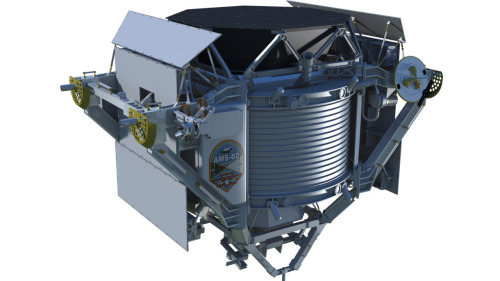
From ESA's pdf I extract some quotes about AMS:
AMS is embarking on a mission to explore distant and
uncharted realms of our Universe, where answers to some longstanding questions in particle physics and cosmology may be revealed and unexpected phenomena may be discovered.
Mission's keywords are cosmic rays, antimatter, dark matter, dark energy.
Cosmic rays are composed by radiation and stable particles from stars, but when they arrive to our planet, they interact with atmosphere. So it is need to use a detector in space, and astronomers and particle physicists are eagerly awaiting the data.
Antimatter is, in a very simple picture, same to the matter but with opposed charge, and is more unstable.
AMS will search for antimatter to the edge of the observable universe.
Finally, according to theories and indirect observations, we know to... unknow 95% of the universe! Experiment was projected by prof.Ting.
Prof. Ting's experiment will increase the sensitivity of the search by between a thousand and a million times, revealing a totally different domain by either finding the neutralino or revealing something else. AMS-02 might also detect a new, exotic form of matter predicted by scientists: a very heavy elementary particle dubbed 'strangelet'.

Another important event is the presence on International Space Station of two italians, Roberto Vittori, who arrived with STS-134 mission. And on ISS there is Paolo Nespoli, who publishes his spectacular photos on flickr.
A great event for all Italian poeple!

(via ESA)