Showing posts with label higgs boson. Show all posts

The Newton Medal is (bit) late

I think there is a subtle black humor in the 2016 Isaac Newton Medal, that was awarded by Tom Kibble:
The award is recognition of his contributions to mankind through his insight into the origins of mass and also through establishing astroparticle physics as a new branch of physics.
Kibble died on the 2nd June 2016 and he cannot retire the prize, but in every case we can remember his most important contribution, Global Conservation Laws and Massless Particles with Gerald Guralnik and Carl Richard Hagen about the Brout-Englert-Higgs mechanism:
An intersting reading about the story behind the paper is The History of the Theory of the Spontaneous Breaking by Guralnik:
Shortly thereafter, as we were literally placing the manuscript in the envelope to be sent to PRL, Kibble came into the office bearing two papers by Higgs and the one by Englert and Brout. These had just arrived in the then very slow and unreliable (because of strikes and the peculiarities of Imperial College) mail. We were very surprised and even amazed. We had no idea that there was any competing interest in the problem, particularly outside of the United States. Hagen and I quickly glanced at these papers and thought that, while they aimed at the same point, they did not form a serious chall enge to our work.

G. S. Guralnik, C. R. Hagen, T. W. B. Kibble, 1964, 'Global Conservation Laws and Massless Particles', Physical Review Letters, vol. 13, no. 20, pp. 585-587 http://dx.doi.org/10.1103/physrevlett.13.585 (sci-hib)
Gerald S. Guralnik, 2009, The History of the Guralnik, Hagen and Kibble development of the Theory of Spontaneous Symmetry Breaking and Gauge Particles, International Journal of Modern Physics A, vol. 24, no. 14, pp. 2601-2627 http://dx.doi.org/10.1142/s0217751x09045431 (arXiv)

Peter about Higgs

Contrary to the custom at this conference, I want first of all to disclaim priority for some of the concepts to which my name is commonly attached in the literature. For this exaggerated view of my originality I have to thank the late Ben Lee, who at the 1972 High Energy Physics Conference at Fermilab plastered my name over almost everything concerned with spontaneous synlnetry breaking.
"Higgs fields", for example, are just the scalar fields of a linear sigma model, which was discussed in 1960 by Gell-Mann and Lévy but had been introduced three years earlier by Schwinger. And "the Higgs mechanism" was first described by Philip Anderson: perhaps it should be called "the ABEGHHK'tH ....mechanism" after all the people (Anderson, Brout, Englert, Guralnik, Hagen, Higgs, Kibble, 't Hooft) who have discovered or rediscovered it! However, I do accept responsibility for the Higgs boson; I believe that I was the first to draw attention to its existence in spontaneously broken gauge theories.
Higgs P. (1993). SBGT and all that, AIP Conference Proceedings, 300 159-163. DOI:

The boson, the spin and the graviton

Some days ago, ATLAS has been released a draft about the spin of the new boson. The decay channels studied are the fab four: $H \rightarrow \gamma \gamma$, $H \rightarrow WW^*$, $H \rightarrow l\nu l\nu$, $H \rightarrow ZZ^* \rightarrow 4l$. The idea is combining data from the four channels in order to understand the spin of the new boson, in detail to distinguish between two cases: spin 0 ($J^P = 0^+$), and so a boson compatible with the Standard Model, and spin 2 ($J^P = 2^+$), that it could be connected with a model (arXiv) that represents a light coupling between the Standard Model's fields and the hypothetical graviton.
These the ATLAS' conclusions:
The data are in good agreement with the expected distributions of a $J^P=0^+$ particle while the graviton-inspired $J^P=2^+$ model, that is expected to be produced dominantly via the gluon fusion process, is excluded at more than 99.9% confidence level.
We could say that it starting the elimination process of the models that would lead the research of the new physics beyond the Standard Model for the next years. A good luck to all of them, but we don't forget the key role of the Standard Model, that is in some sense confirmed by this last draft from ATLAS.

Play the game with the Higgs boson

In the mid-March at Moriond 2013 ATLAS and CMS presented the last results about the research of the Higgs' boson. While CMS reduced the excess for the $H \rightarrow \gamma \gamma$ decay channell, ATLAS continued to observe it. This result could be a clue that the boson discovered and announced last year is only the first of a series of Higgs' bosons. Indeed, following Albert De Roeck of CSM, the photon decay could be connected with...
new physics and there are a great deal of models that can come with such a number
In order to resolve the question (is the new boson the only Higgs' boson or simply a Higgs' boson?) we have to wait the end of the maintenance work of LHC, but in the meantime we could play with the Quark Matter Card Game, in particular the variant named Higgs Boson - on Your Own!
Object of the game: to win, by detecting a decay of a Higgs boson. If this does not happen in a given game, one can win by statistics, by collecting the largest number of particle cards.
The proposed game is a variation of Memory

Is it the Higgs? The spin will tell us!

a couple of video about #Higgs via @CMSexperiment posted by @ulaulaman
The CMS experiment posted on its Google Plus page a couple of video about the new boson and the future research of its spin, an important tool in order to understand if the new particle is a Higgs boson or someone like it, but with some, little differences:

Habemus papers (about the new boson)

posted by @ulaulaman thanks to @tanzmax @spimpompam #Higgs #boson #newboson #LHC #CMS #ATLAS #CERN
Finally Physics Letters B published the two papers by ATLAS and CMS about the discovery of the new boson at LHC (via tanzmax):
A search for the Standard Model Higgs boson in proton–proton collisions with the ATLAS detector at the LHC is presented. The datasets used correspond to integrated luminosities of approximately $4.8 \, fb^{−1}$ collected at $\sqrt{s} = 7$ TeV in 2011 and $5.8 \, fb^{−1}$ at $\sqrt{s} = 8$ TeV in 2012. Individual searches in the channels $H \rightarrow ZZ^{(*)} \rightarrow 4l$, $H \rightarrow \gamma \gamma$ and $H \rightarrow WW^{(*)} \rightarrow e \nu \mu \nu$ in the 8 TeV data are combined with previously published results of searches for $H \rightarrow ZZ^{(*)}$, $WW^{(*)}$, $b \bar{b}$ and $\tau^+ \tau^-$ in the 7 TeV data and results from improved analyses of the $H \rightarrow ZZ^{(*)} \rightarrow 4l$ and $H \rightarrow \gamma \gamma$ channels in the 7 TeV data. Clear evidence for the production of a neutral boson with a measured mass of 126.0 ± 0.4 (stat) ± 0.4 (sys) GeV is presented. This observation, which has a significance of 5.9 standard deviations, corresponding to a background fluctuation probability of 1.7 × 10⁻⁹, is compatible with the production and decay of the Standard Model Higgs boson.
Aad, G., Abajyan, T., Abbott, B., Abdallah, J., Abdel Khalek, S., Abdelalim, A.A., Abdinov, O., Aben, R., Abi, B., Abolins, M. & (2012). Observation of a new particle in the search for the Standard Model Higgs boson with the ATLAS detector at the LHC, Physics Letters B, 716 (1) 29. DOI: 10.1016/j.physletb.2012.08.020
Results are presented from searches for the standard model Higgs boson in proton–proton collisions at $\sqrt{s} =$ 7 and 8 TeV in the Compact Muon Solenoid experiment at the LHC, using data samples corresponding to integrated luminosities of up to $5.1 fb^{−1}$ at 7 TeV and $5.3 fb^{−1}$ at 8 TeV. The search is performed in five decay modes: $\gamma \gamma$, $ZZ$, $W^+ W^−$, $\tau^+ \tau^-$, and $b \bar{b}$. An excess of events is observed above the expected background, with a local significance of 5.0 standard deviations, at a mass near 125 GeV, signalling the production of a new particle. The expected significance for a standard model Higgs boson of that mass is 5.8 standard deviations. The excess is most significant in the two decay modes with the best mass resolution, $\gamma \gamma$ and $ZZ$; a fit to these signals gives a mass of 125.3 ± 0.4 (stat.) ± 0.5 (syst.) GeV. The decay to two photons indicates that the new particle is a boson with spin different from one.
Chatrchyan, S., Khachatryan, V., Sirunyan, A.M., Tumasyan, A., Adam, W., Aguilo, E., Bergauer, T., Dragicevic, M., Erö, J., Fabjan, C. & (2012). Observation of a new boson at a mass of 125 GeV with the CMS experiment at the LHC, Physics Letters B, 716 (1) 61. DOI: 10.1016/j.physletb.2012.08.021

To the previous papers, I add also the following (via spimpompam), that it could be interesting to read:
Following recent ATLAS and CMS publications we interpret the results of their Higgs searches in terms of Standard Model operators. For a Higgs mass of 125 GeV we determine several Higgs couplings from 2011 data and extrapolate the results towards different scenarios of LHC running. Even though our analysis is limited by low statistics we already derive meaningful constraints on modified Higgs sectors.
Klute, M., Lafaye, R., Plehn, T., Rauch, M. & Zerwas, D. (2012). Measuring Higgs Couplings from LHC Data, Physical Review Letters, 109 (10) DOI: 10.1103/PhysRevLett.109.101801 (arXiv)

Les Cernettes

posted by @ulaulaman about #LesHorriblesCernettes #music #cern #HardronicMusicFestival
Les Horribles Cernettes is a rock-swing group that started its activity with the... birth of the web!
Indeed the first photo uploaded on web by Tim Berners-Lee was a promotional photoshop by the fab four girl from LHC!
The group is, today, formed by three girls Michele de Gennaro, Anne MacNabb, Colette Marx-Nielsen, and this is the original story from the official web site:
Once upon a summer there was a girl. She was a CERN secretary tired of waiting day and night for her permanently-on-shift physicist boyfriend, and so she decided to attract his attention by stepping on stage during the CERN Hardronic Festival to sing about her lonely nights in front of the entire CERN population. She asked Silvano [de Gennaro, an IT developer who worked with Tim Berners-Lee] to write a song about her life and a couple of girlfriends to back her up on stage. A few weeks later the Cernettes were on stage for the first time, for the delight of thousands of happy Physicists, singing Collider, the song that since that day became the National Anthem of the High Energy Kingdom.
Their first success was Liquid Nitrogen, but today I would share a live version of Mr. Higgs:

Discovering a boson

posted by @ulaulaman #Higgs #ICHEP2012
I'm partially wrong! Yesterday I write that no Higgs could be announced, but today ATLAS and CMS presented the observation of a new boson, that it's to soon to identify with certainty like the Higgs boson, but it is certainly a new boson to add to the picture of the universe. The next quest is to find its properties and to confront with the theoretical properties of the Higgs boson. It could be that the new boson presented today could be different for a bit of properties from the Higgs, but this is not so incredible: like I write, with a Higgs boson with a mass around 125 GeV, we need other ingredients to complete a picture of our stable universe.

Candidate Higgs decay to four electrons recorded by ATLAS in 2012 (source ATLAS)
But... what did it happen today?
The two experiments, CMS, represented by Joe Incandela, and ATLAS, represented by Fabiola Gianotti, showed the results of their last data elaboration about Higgs research. The results come from the combination of the complete data set from 2011 (see, for example, the ATLAS' preprint) with the first part of data from 2012. The conclusions are: CMS sees an excess with $m_H = 125.3 \pm 0.6 GeV$ with a significance of $4.9 \sigma$; ATLAS sees an excess with $m_H = 126.5 GeV$ with a significance of $5.0 \sigma$, that it means discover!

CMS' final result

ATLAS' final result

Are we close to discovering the Higgs Boson?

#Higgs #ICHEP2012 #CERN #LHC #LargeAdronCollider
Today ATLAS and CMS will present, during two scientific conferences, their results with the complete set of data from 2011. ATLAS has also released a preprint, submitted to the Physical Review D, in which the experiment propose a measure for the Higgs mass: $m_H = 126GeV$ with a significance of $2.9 \sigma$ (like I wrote yesterday). There are not the numbers for a discover, but we are really close to the Higgs boson, like John Ellis explains in the following video:
You can follow the conference in webcast, on internet thanks to the live blogging from Sean Carroll, or following the hashtags on twitter: #Higgs #ICHEP2012 #CERN #LHC #LargeAdronCollider.

Higgs? Probably not tomorrow

posted by @ulaulaman about #Higgs #higgsboson #ATLAS
I try to explain because I think that tomorrow it will not be the announce of the Higgs boson discover. First of all the official statements of Sergio Bertolucci, CERN Director for Research and Computing (CERN press release):
We now have more than double the data we had last year that should be enough to see whether the trends we were seeing in the 2011 data are still there, or whether they've gone away. It's a very exciting time.
and of James Gillies, CERN spokesman (Not Even Wrong):
Combining the data from two experiments is a complex task, which is why it takes time, and why no combination will be presented on Wednesday.
And today, a preprint is published by ATLAS: Combined search for the Standard Model Higgs boson in pp collisions at sqrt(s) = 7 TeV with the ATLAS detector
A combined search for the Standard Model Higgs boson with the ATLAS detector at the LHC is presented. The datasets used correspond to integrated luminosities from 4.6 $fb^-1$ to 4.9 $fb^-1$ of proton-proton collisions collected at sqrt(s) = 7 TeV in 2011. The Higgs boson mass ranges of 111.4 GeV to 116.6 GeV, 119.4 GeV to 122.1 GeV, and 129.2 GeV to 541 GeV are excluded at the 95% confidence level, while the range 120 GeV to 560 GeV is expected to be excluded in the absence of a signal. An excess of events is observed at Higgs boson mass hypotheses around 126 GeV with a local significance of 2.9 standard deviations (sigma). The global probability for the background to produce an excess at least as significant anywhere in the entire explored Higgs boson mass range of 110-600 GeV is estimated to be ~15%, corresponding to a significance of approximately one sigma.
I must rember you that, to declare a discover of a new particle, the result must be released with 5 sigma, and ATLAS data is given with 2.9 sigma(1).
We are really near to the Higgs boson, but we don't have the certainty, so I think that tomorrow nobody say We have discovered the Higgs boson (but I could be wrong).

Higgs at the Tevatron

posted by @ulaulaman about #higgs #physics #tevatron
This is the week of the Higgs. Indeed, wednesday, at CERN, ATLAS and CMS announced the results of the elaboration of the data collected in the first part of 2012... and a lot of journalists write about the probable discover of the Higgs boson. Indeed the two collaborations are disegned in order to discover the boson related to the mechanism that provides the mass to the other particles. Waiting for the conference, today CDF and DZero, the two collaborations of Tevatron, publicize in two conferences the first elaboration of the complete set of data about Higgs research. Their result was summarize by the following plot:
In the image there is the combination of the final results from the two collaborations. The two experiments combined detecte an excess in signals around 125 GeV with a 2.5 sigma. It is not the discover of the Higgs boson, but it could be a good clue for the existence of the boson. So I don't know if ATLAS and CMS will confirm or update this result in their next conferences, but in every case I must remmber to the readers that with a mass of 125 GeV we have need of physics beyond Standard Model, because the only SM is not sufficient to explain our universe. In order to explain better, I reprint here some considerations that I just published for the previous Higgs day:

Higgs' research: CDF and D0 confirm ATLAS and CMS results

Do you remember the conference of ATLAS and CMS about their Higgs' preliminary results? Well. Today during Moriond 2012 conference, the two Tevatron's collaboration, CDF and D0, presented their results about Higgs research:

(the plot shows the upper limit on the Higgs boson production rate)
In synthesis they confirm LHC's results (Tevatron's Higgs range: 115 GeV - 135 GeV, with $sigma = 2.2$).
More details on: Fermi Lab's press release, Tommaso Dorigo, the source of the image.
Special thanks to Peppe Liberti.

Higgs day

I've just write on my italian blog that:
There will be no dramatic announcement, but only new and more stringent limits on the Higgs mass(1)
and the conclusion of the today Higgs' event confirms that impression. Indeed Fabiola Gianotti and Giulio Tonani, respectively spokespersons of ATLAS and CMS, during their CERN's seminars presented the new limits about Higgs mass, and in the combination of the data presented in the official press release (the combination dued by the two experiments will arrive only after the publication of the papers) we can read the new limits: from 124 to 126 GeV.
After the two seminars I discussed via e-mail with Salvatore Fazio, who send me the following two plots about the preliminary results from ATLAS and CMS
and the superposition of the two previous plots:
He also comments:

A circle around Higgs boson

After the post about D0 abstracts, I return to write about Higgs boson after the last Fermilab's press release about the mass limit of Higgs boson. Combinig data from D0 and CDF, Tevatron's limits are 114-137 GeV/c2. The results was presented last week in Grenoble at the EPS High-Energy Physics conference, that it will finish on the 27th July.
During the same conference also LHC's experiments presented their first results, analyzed in about one month! And the conclusion seems un-huppy for Tevatron: the Fermilab's particle accelerator has only one chance to find Higgs boson before LHC. Why? We can simply see the following plots presented by ATLAS and CMS (via Résonaances, Tommaso Dorigo):

The two european experiments presented only a little region around 115 GeV/c2, the Tevatron's region, to 140 GeV/c2. The data from this region are probably analized and published before the end of the year, so we must wait only some months to know if Tevatron could found Higgs or not(1).
Tomasso examined in details some CMS preprint in which they are studied a lot of Higgs production channels, and also Philip Gibbs write a great summary about LHC presentations, who realize a great conclusion plot:

D0 abstracts: Higgs limits and dimuon asymmetry

I usually publish abstract's digests on posterous, but in this case I think this is necessary an exception. D0 collaboration at Tevatron, indeed, released two papers on arxiv, and I think that it is important sharing with the much number of readers their work. I startwith Search for neutral Higgs bosons decaying to $\tau$ pairs produced in association with $b$ quarks in $p \bar{p}$ collisions at $\sqrt s = 1.96$ TeV, shared by Tommaso:
hmssm_dzero_1.jpg
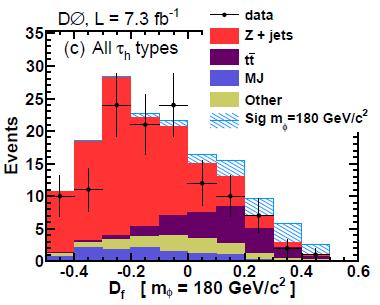
We report results from a search for neutral Higgs bosons produced in association with b quarks using data recorded by the D0 experiment at the Fermilab Tevatron Collider and corresponding to an integrated luminosity of 7.3 $fb^{-1}$. This production mode can be enhanced in several extensions of the standard model (SM) such as in its minimal supersymmetric extension (MSSM) at high tanBeta. We search for Higgs bosons decaying to tau pairs with one tau decaying to a muon and neutrinos and the other to hadrons. The data are found to be consistent with SM expectations, and we set upper limits on the cross section times branching ratio in the Higgs boson mass range from 90 to 320 $GeV/c^2$. We interpret our result in the MSSM parameter space, excluding tanBeta values down to 25 for Higgs boson masses below 170 $GeV/c^2$.
The other two papers are in Antimatter Tevatron mystery gains ground, a great BBC's article. In particular BBC writes about Measurement of the anomalous like-sign dimuon charge asymmetry with 9 $fb^{-1}$ of $p \bar{p}$ collisions: