Showing posts with label inaf. Show all posts

The architecture of Pi Mensae

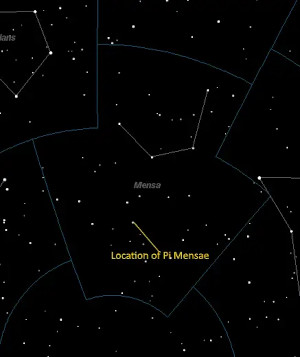
20240905-pi-mensae-location
Few days before the formal acceptance of this paper, an independent study about the architecture of the π Men planetary system was published(1). The results of that work, based on public data and not including the ESPRESSO observations, confirm the high mutual inclination of the orbital planes of π Men b and c. Our results are in agreement with those of Xuan & Wyatt and are characterized by a better formal precision.(2)
Pi Mensae, or π Men, is a yellow dwarf star in the constellation of Mensa. We know that it has a little planetary system, constituted by two planets (or, if you prefer, we discover only two planets orbiting around Pi Mensae): Pi Mensae b, one of the most massive planets ever discovered, about 14.1 the mass of Jupiter, and Pi Mensae c, a super-Earth, about 4.5 the mass of our planet.
In 2020, an analysis with Gaia DR2 and Hipparcos astrometry showed that planets b and c are located on orbits mutually inclined by 49°-131°, which causes planet c to not transit most of the time, and acquire large misalignments with its host star's spin axis(1).
This result was discovered also by an italian team(2), but published just few days after on arXiv, using ESPRESSO (Echelle Spectrograph for Rocky Exoplanet- and Stable Spectroscopic Observations), a sèectrograph designed and developed in Italy by researchers of Brera's Astronomical Observatory at the Merate's laboratories. The instrument, mounted on the Very Large Telescope, has in a certain sense been tested with the planetary system of Pi Mensae, therefore, even coming seconds for a few, the result can be considered a success for the young ESPRESSO.
  1. Xuan, J. W., & Wyatt, M. C. (2020). Evidence for a high mutual inclination between the cold Jupiter and transiting super Earth orbiting π Men. Monthly Notices of the Royal Astronomical Society, 497(2), 2096-2118. doi:10.1093/mnras/staa2033 (arXiv) ↩︎ ↩︎

  2. Damasso, M., Sozzetti, A., Lovis, C., Barros, S. C. C., Sousa, S. G., Demangeon, O. D. S., ... & Rebolo, R. (2020). A precise architecture characterization of the π\pi Men planetary system. A&A, Forthcoming article doi:10.1051/0004-6361/202038416 (arXiv) ↩︎ ↩︎
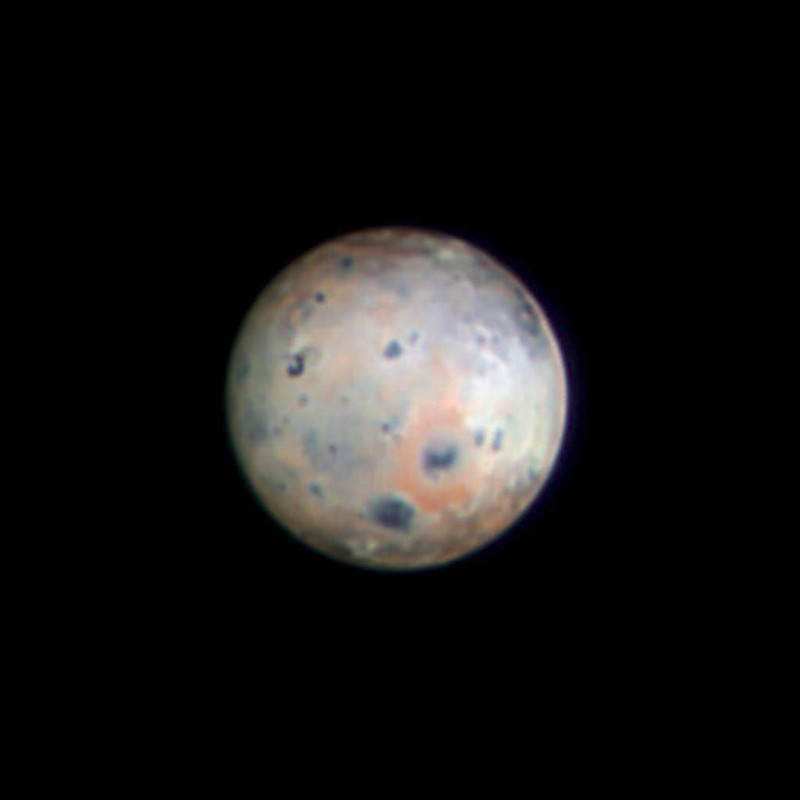
Portrait of a Jovian satellite

io-SHARK-VIS-LBT
The Jovian moon Io, imaged by SHARK-VIS@LBT on January 10, 2024. The red, green, and blue channels of this tri-color image show the I (infrared), R (red), and V (green) spectral bands, respectively (corresponding at wavelengths of 755, 620 and 550 nanometers). This is the highest resolution image of Io ever obtained from a ground-based telescope.

The breath of the ancestors

J0923-0402
A research team led by the INAF (Istituto Nazionale di Astrofisica) and the University of Trieste has once again harnessed the very distant and energetic relativistic winds generated by a distant but decidedly active quasar (one of the brightest discovered so far). A study published in The Astrophysical Journal reports the first observation at different wavelengths of the interaction between the black hole and the quasar of the host galaxy J0923+0402 during the initial phases of the Universe, about 13 billion years ago (when the Universe was less than a billion years old). In addition to evidence of a gas storm generated by the black hole, experts have discovered for the first time a halo of gas extending well beyond the galaxy, suggesting the presence of material ejected from the galaxy itself via winds generated by the black hole.
Our study helps us understand how gas is expelled or captured by galaxies in the young Universe and how black holes grow and can impact the evolution of galaxies. We know that the fate of galaxies such as the Milky Way is closely linked to that of black holes, since these can generate galactic storms capable of extinguishing the formation of new stars. Studying the primordial eras allows us to understand the initial conditions of the Universe we see today. - Manuela Bischetti

The action of UV-C against covid19

The research about the action of ultraviolet radiation against covid19 arrived at an interesting conclusion: the team, leaded by Istituto Nazionale di Astrofisica and Università Statale di Milano and with the collaboration of Istituto nazionale dei tumori and Irccs, has provided the first experimental data about the high germicidal power of ultraviolet rays against Sars-Cov-2.
Andrea Bianco, head of the astronomers' team, says to MediaINAF (Google Translate):
We have seen very distinct behaviors. At the lowest concentration, we had to wait six days for the virus to replicate and infect cells without being subjected to UV-C illumination. In the intermediate concentration, which we took as a reference, already with the lowest dose of irradiation, after 24 hours we had a reduction of a factor greater than 1000. Waiting longer, we saw that the virus no longer grows back, that is, it is no longer able to replicate itself: it is said that it has been completely inhibited. While in the highest concentration, at the lowest dose of irradiation, at the beginning there is a fairly significant decrease in the amount of active virus but after it goes back up, which means that the virus has been inactivated but the concentration is so high that it is able to restart (because it has not been completely inhibited). When we gave him the second dose - 16.7 mJ / cm2 - it was seen that it is sufficient to completely inhibit him : even after 72 hours he is unable to "regain his strength". In this high concentration of the virus, therefore, this aspect emerged: at low doses I can have a significant decrease in the active virus but he is still able to infect the cells, so after a certain time he restarts with his activity.
But:
Going from Uv-A to Uv-C the danger for man increases, in the sense that Uv-C radiation causes mutations, therefore increases the probability of having skin cancers considerably. So much so that, by law, the maximum dose of Uv-C that one can take daily is very low. Uv-B and Uv-A are much less so, so much so that we tan, protecting ourselves with creams to avoid the risk of cancer and skin rashes. The risk is there but with much less probability.
Bianco, A., Biasin, M., Pareschi, G., Cavalleri, A., Cavatorta, C., Fenizia, C., ... & Saulle, I. (2020). UV-C irradiation is highly effective in inactivating and inhibiting SARS-CoV-2 replication. medRxiv. doi:10.1101/2020.06.05.20123463
The potential virucidal effects of UV-C irradiation on SARS-CoV-2 were experimentally evaluated for different illumination doses and virus concentrations (1000, 5, 0.05 MOI). Both virus inactivation and replication inhibition were investigated as a function of these parameters. At a virus density comparable to that observed in SARS-CoV-2 infection, an UV-C dose of just 3.7 mJ/cm2 was sufficient to achieve a 3-log inactivation, and complete inhibition of all viral concentrations was observed with 16.9 mJ/cm2. These results could explain the epidemiological trends of COVID-19 and are important for the development of novel sterilizing methods to contain SARS-CoV-2 infection.
Nicastro, F., Sironi, G., Antonello, E., Bianco, A., Biasin, M., Brucato, J. R., ... & Trabattoni, D. (2020). Modulation of COVID-19 Epidemiology by UV-B and-A Photons from the Sun. medRxiv. doi:10.1101/2020.06.03.20121392
It is well known that 200-290 nm ultraviolet photons (hereinafter UV-C radiation) photo-chemically interacts with DNA and RNA and are endowed with germicidal properties that are also effective on viruses. Fortunately, Solar UV-C photons of this wavelength are filtered out by the Ozone layer of the upper Atmosphere, at around 35 km. Softer UV photons from the Sun with wavelengths in the range 290-320 nm (UV-B) and 320-400 nm (UV-A), however, do reach the Earth s surface. The effect of these photons on Single- and Double-Stranded RNA/DNA viruses and the possible role they play on the seasonality of epidemics, are nevertheless little studied and highly debated in alternative or complementarity to other environmental causes. Notably though, the effects of both direct and indirect radiation from the Sun needs to be considered in order to completely explain the effects of UV radiations in life processes (with e.g. the UV virucidal effect enhanced in combination to the concomitant process of water droplets depletion because of Solar heat). Herein we present a number of concurring circumstantial evidence suggesting that the evolution and strength of the recent Severe Acute Respiratory Syndrome (SARS-Cov-2) pandemics, might be have been modulated by the intensity of UV-B and UV-A Solar radiation hitting different regions of Earth during the diffusion of the outbreak between January and May 2020. Out findings, if confirmed by more in depth data analysis and modeling of the epidemics, which includes Solar modulation, could help in designing the social behaviors to be adopted depending on season and environmental conditions.

Road to Mercury: flyby with Earth

A flyby is close passage of a space probe, at high speed, near a planet or other celestial object. It can be used to speed up or slow down the space probe.
The first successful planetary flyby ever made was performed the 14th December 1962 by the Mariner 2 NASA spacecraft with the planet Venus, but it was with the Mariner 10 mission, thanks to an intuition of the italian Mathematician Giuseppe Colombo in 1970, that we use now the flyby as orbital correction maneuver. Indeed, the professor from Paduan was invited from the JPL to participate in a conference about the Mariner 10 directed to Mercury. When he observed the spacecraft computed orbit, he noted that the Mariner 10 would have an orbital period around the sun twice the Mercury year. Hence, he suggested to carfully calibrate the first passage over Mercury in such a way that the spacecraft would have exactly the delta velocity from the planet to re-encounter Mercury at the next revolution. His suggestion was fully accepted and, thanks to him, Mercury 10 (llaunched in the 1973 on its way to Venus) had its first flyby with Mercury on 5th February 1974, and a second a third flyby on 21th September 1974, and also a third on 16th March 1975. The change in trajectory found by Giuseppe Colombo allowed to greatly increase the scientific return of the mission, as well as the scientific knowledge of the planet Mercury.
(...)
On the early morning of the 10th of April, there will be the possibility, hopefully, to observe the crossing on the sky of BepiColombo spacecraft crossing the sky from East to West. The closest approach is foreseen at 04.25 UTC with a minimum distance of 12.677 km from the Earth's surface.
If you want to compute your own plot for your location by inserting latitude and longitude here: https://bepicolombo.iaps.inaf.it.

source: esa