
We survey a variety of cosmological problems where the issue of generality has arisen. This is aimed at providing a wider context for many claims and deductions made when philosophers of science choose cosmological problems for investigation. We show how simple counting arguments can be used to characterise parts of the general solution of Einstein's equations when various matter fields are present and with different spatial topologies. Applications are described to the problem of singularities, static cosmological models, cosmic no hair theorems, the late-time isotropisation of cosmological models, and the number of parameters needed to describe a general astronomical universe.

Showing posts with label arxiv. Show all posts
Showing posts with label arxiv. Show all posts
John Barrow: Some Generalities About Generality
On 1 December 2014 I had the pleasure of attending a lecture by John David Barrow at the "Enriques" Department of Mathematics in Milano. Very kind person, when I approached him to be able to shake his hand and take a picture of him, he granted me both honors with great simplicity. Unfortunately that photo has now been lost among smartphone changes, perhaps kept in some hard disk stored somewhere, nor did I publish it on one of my social networks, but I still wanted to pay homage to it by offering you the abstract of an article from 2015, the fifth chapter of the book The Philosophy of Cosmology (arXiv):
SphereX: the road to BB-8

Wheeled planetary rovers such as the Mars Exploration Rovers (MERs) and Mars Science Laboratory (MSL) have provided unprecedented, detailed images of the Mars surface. However, these rovers are large and are of high-cost as they need to carry sophisticated instruments and science laboratories. We propose the development of low-cost planetary rovers that are the size and shape of cantaloupes and that can be deployed from a larger rover. The rover named SphereX is 2 kg in mass, is spherical, holonomic and contains a hopping mechanism to jump over rugged terrain. A small low-cost rover complements a larger rover, particularly to traverse rugged terrain or roll down a canyon, cliff or crater to obtain images and science data. While it may be a one-way journey for these small robots, they could be used tactically to obtain high-reward science data. The robot is equipped with a pair of stereo cameras to perform visual navigation and has room for a science payload. In this paper, we analyze the design and development of a laboratory prototype. The results show a promising pathway towards development of a field system.The litle robot was tested under simulated lunar and martian gravity conditions, and the results are encouraging:
It was observed that as angle of separation between grouser decreases there is increase in average speed of robot and the power consumption remains almost constant. A hopping mechanism was developed for the robot that enables the robot to in theory perform unlimited hops. Currently the system is able to perform a hop of 8-10 cm under simulated Martian gravity. Extrapolating this, we would be able to achieve 16-20 cm hop in lunar conditions. The performance of hopping mechanism has to be improved to achieve the stated mission requirements. Based on power consumption for each hop and maximum power available, it was calculated that the robot would be able to produce maximum 208 hops in a single charge and robot would operate for 35 minutes of continuous hopping. The proposed SphereX design shows a promising pathway towards further maturation and testing of the technology in the field.
How to produce stationary wave fields

A cylindrical surface of stationary light from
Zamboni-Rached, M., Recami, E., & Hernández-Figueroa, H. (2005). Theory of "frozen waves": modeling the shape of stationary wave fields Journal of the Optical Society of America A, 22 (11) DOI: 10.1364/JOSAA.22.002465 (arXiv)
Method for producing a stationary wave field of arbitrary shape comprising the steps of defining at least one volume being limited in the direction of the axis of propagation of a beam, of the type $0 \leq z \leq L$; defining an intensity pattern within the said region $0 \leq z \leq L$ by a function $F(z)$, describing the said localized and stationary intensity pattern, which is approximated by means of a Fourier expansion or by a similar expansion in terms of (trigonometric) orthogonal functions; providing a generic superposition of Bessel or other beams highly transversally confined; calculating the maximum number of superimposed Bessel beams the amplitudes, the phase velocities and the relative phases of each Bessel beam of the superposition, and the transverse and longitudinal wavenumbers of each Bessel beam of the superposition.The invention is based on the following theoretical papers:
The Marvel Universe as a real social network

Cover of the first number of Marvel Team-Up, comic book dedicated to the collaborations between Marvel heroes
We investigate the structure of the Marvel Universe collaboration network, where two Marvel characters are considered linked if they jointly appear in the same Marvel comic book. We show that this network is clearly not a random network, and that it has most, but not all, characteristics of "real-life" collaboration networks, such as movie actors or scientific collaboration networks. The study of this artificial universe that tries to look like a real one, helps to understand that there are underlying principles that make real-life networks have definite characteristics.
R. Alberich, J. Miro-Julia, & F. Rossello (2002). Marvel Universe looks almost like a real social network arXiv arXiv: cond-mat/0202174v1
Some geometrical aspects of 3- and 4-spaces
A couple of abstracts about the geomtery of space:


Historically, there have been many attempts to produce the appropriate mathematical formalism for modeling the nature of physical space, such as Euclid's geometry, Descartes' system of Cartesian coordinates, the Argand plane, Hamilton's quaternions, Gibbs' vector system using the dot and cross products. We illustrate however, that Clifford's geometric algebra (GA) provides the most elegant description of physical space. Supporting this conclusion, we firstly show how geometric algebra subsumes the key elements of the competing formalisms and secondly we show how it provides an intuitive representation and manipulation of the basic concepts of points, lines, areas and volumes. We also provide two examples where GA has been found to provide an improved description of two key physical phenomena, electromagnetism and quantum theory, without using tensors or complex vector spaces. This paper also provides pedagogical tutorial-style coverage of the various basic applications of geometric algebra in physics.
James M. Chappell, Azhar Iqbal & Derek Abbott (2011). Geometric Algebra: A natural representation of three-space, arXiv: 1101.3619v3
We indicate that Heron's formula (which relates the square of the area of a triangle to a quartic function of its edge lengths) can be interpreted as a scissors congruence in 4-dimensional space. In the process of demonstrating this, we examine a number of decompositions of hypercubes, hyper-parallelograms, and other elementary 4-dimensional solids.
J. Scott Carter & David A. Mullens (2015). Some Elementary Aspects of 4-dimensional Geometry, arXiv: 1504.01727v1
There's also a minimalistic introduction to euclidean planes.
Learning abstracts: from mathematics, to the neural trasnformation machines
A coulpe of abstracts about e-learning:

This paper presents a new framework for adding semantics into e-learning system. The proposed approach relies on two principles. The first principle is the automatic addition of semantic information when creating the mathematical contents. The second principle is the collaborative tagging and annotation of the e-learning contents and the use of an ontology to categorize the e-learning contents. The proposed system encodes the mathematical contents using presentation MathML with RDFa annotations. The system allows students to highlight and annotate specific parts of the e-learning contents. The objective is to add meaning into the e-learning contents, to add relationships between contents, and to create a framework to facilitate searching the contents. This semantic information can be used to answer semantic queries (e.g., SPARQL) to retrieve information request of a user. This work is implemented as an embedded code into Moodle e-learning system.
Iyad Abu Doush, Faisal Alkhateeb, Eslam Al Maghayreh, Izzat Alsmadi & Samer Samarah (2012). Annotations, Collaborative Tagging, and Searching Mathematics in E-Learning, arXiv: 1211.1780v1
As far as Learning Management System is concerned, it offers an integrated platform for educational materials, distribution and management of learning as well as accessibility by a range of users including teachers, learners and content makers especially for distance learning. Usability evaluation is considered as one approach to assess the efficiency of e-Learning systems. It is used to evaluate how well technology and tools are working for users. There are some factors contributing as major reason why LMS is not used effectively and regularly. Learning Management Systems, as major part of e-Learning systems, can benefit from usability research to evaluate the LMS ease of use and satisfaction among its handlers. Many academic institutions worldwide prefer using their own customized Learning Management Systems; this is the case with Moodle, an open source Learning Management Systems platform designed and operated by most of the universities in Sri Lanka. This paper gives an overview of Learning Management Systems used in Sri Lankan universities, and evaluates its usability using some pre-defined usability standards. In addition it measures the effectiveness of Learning Management System by testing the Learning Management Systems. The findings and result of this study as well as the testing are discussed and presented.
Selvarajah Thuseethan, Sivapalan Achchuthan & Sinnathamby Kuhanesan (2015). Usability Evaluation of Learning Management Systems in Sri Lankan Universities, Global Journal of Computer Science and Technology, 15 (1) arXiv: 1412.0197v2
And the last abstract about the learning processo in neural network:
We propose Neural Transformation Machine (NTram), a novel architecture for sequence-to-sequence learning, which performs the task through a series of nonlinear transformations from the representation of the input sequence (e.g., a Chinese sentence) to the final output sequence (e.g., translation to English). Inspired by the recent Neural Turing Machines [8], we store the intermediate representations in stacked layers of memories, and use read-write operations on the memories to realize the nonlinear transformations of those representations. Those transformations are designed in advance but the parameters are learned from data. Through layer-by-layer transformations, NTram can model complicated relations necessary for applications such as machine translation between distant languages. The architecture can be trained with normal back-propagation on parallel texts, and the learning can be easily scaled up to a large corpus. NTram is broad enough to subsume the state-of-the-art neural translation model in [2] as its special case, while significantly improves upon the model with its deeper architecture. Remarkably, NTram, being purely neural network-based, can achieve performance comparable to the traditional phrase-based machine translation system (Moses) with a small vocabulary and a modest parameter size.
Fandong Meng, Zhengdong Lu, Zhaopeng Tu, Hang Li & Qun Liu (2015). Neural Transformation Machine: A New Architecture for Sequence-to-Sequence Learning, arXiv: 1506.06442v1
Math education: calculus in South Korea and the Rubik's cube

N. Karjanto (2015). Calculus teaching and learning in South Korea Jurnal Matematika Integratif 9(2): 179-193, 2013 arXiv: 1504.07803v1
This article discusses an experience of teaching Calculus classes for the freshmen students enrolled at Sungkyunkwan University, one of the private universities in South Korea. The teaching and learning approach is a balance combination between the teacher-oriented traditional style of lecturing and other activities that encourage students for active learning and classroom participation. Based on the initial observation during several semesters, some anecdotal evidences show that students' learning is improved after implementing this student-oriented active learning approach, albeit a longer period of time is definitely needed to transform general students' attitude from passive learners to active ones.From the conclusion I would emphasize the following paragraph:
From this study we have seen some anecdotal evidences that students' learning is improved when they are actively engaged with the study material, instead of only sitting passively in the classroom and listening to the lecture. More success can be achieved when the classroom activities are also fun. With a proper balance between lecturing and engaging students new concepts and activities in which students, alone or in groups, need to struggle themselves with these concepts, makes the learning time in the classroom more effective and the time spent in class becomes more enjoyable for the students. Students also show appreciation for this style of teaching. Despite classroom participation and group activities are generally more successful in classes with a small number of students, some promising and good results have been accomplished even though the class sizes were relatively large.
Sandor Kiss (2015). Educational Challenges of Rubik's Cube X Workshop on Particle Correlations and Femtoscopy arXiv: 1505.00750v1
The first 2x2x2 twisty cube was created as a demonstration tool by Erno Rubik in 1974 to help his students understand the complexity of space and the movements in 3D. He fabricated a novel 3x3x3 mechanism where the 26 cubies were turning, and twisting independently, without falling apart. The cube was dressed in sophisticated colors which made it a unique puzzle. Even without instruction is the aim of the game was self-explanatory. Its educational value in VSI (Visual-Spatial Intelligence), developing strategy, memorization and logistics, improve concentration and persistence in problem solving is high in every age group. A logical puzzle has outreach far beyond. Those aspects are briefly covered in this article.
Alan Turing's declassified papers

1. The Statistics of Repetitions
In order to be able to obtain reliable estimates of the value of given repeats we need to have information about repetition in plain language. Suppose for example that we have placed two messages together and that we find repetitions consisting of a tetragramme, two bigrammes, and fifteen single letters, and that the total overlap was 105, i.e. that the maximum possible number of repetitions which could be obtained by altering letters of the messages is 105; suppose also that the lengths of the messages are 200 and 250; in such a case what is the probability of the fit being right, no other information about the day's traffic being taken into consideration, but information about the character of the enciphered text being available in considerable quantity?2. The Applications of Probability to Cryptography
The theory of probability may be used in cryptography with most effect when the type of cipher used is already fully understood, and it only remains to find the actual keys. It is of rather less value when one is trying to diagnose the type of cipher, but if definite rival theories about the type of cipher are suggested it may be used to decide between them.
Riemann zeta function's fractal

The quadratic Mandelbrot set has been referred to as the most complex and beautiful object in mathematics and the Riemann Zeta function takes the prize for the most complicated and enigmatic function. Here we elucidate the spectrum of Mandelbrot and Julia sets of Zeta, to unearth the geography of its chaotic and fractal diversities, combining these two extremes into one intrepid journey into the deepest abyss of complex function space.Fractal Geography of the Riemann Zeta Function by Chris King
Black holes and revelations: their large interiors
The 3d volume inside a spherical black hole can be defined by extending an intrinsic flat-spacetime characterization of the volume inside a 2-sphere. For a collapsed object, the volume grows with time since the collapse, reaching a simple asymptotic form, which has a compelling geometrical interpretation. Perhaps surprising, it is large. The result may have relevance for the discussion on the information paradox.
Marios Christodoulou & Carlo Rovelli (2014). How big is a black hole?, arXiv: http://arxiv.org/abs/1411.2854v2

A sphere $S$ on the event horizon bounds a spacelike hypersurface, a large portion of which coincides with an $r$ = constant hypersurface. We show this hypersurface with one dimension suppressed, and cut in the middle, omitting the long cylindrical part which gives the main contribution to its volume. We also illustrate the argument showing that most of the volume is contained in a region out of causal contact with matter that has advanced far into the black hole.
Ingemar Bengtsson & Emma Jakobsson (2015). Black holes: Their large interiors, arXiv: http://arxiv.org/abs/1502.01907v1
Black holes and revelations: the seeds of the galaxies

In this paper we present a new scenario where massive Primordial Black Holes (PBH) are produced from the collapse of large curvature perturbations generated during a mild waterfall phase of hybrid inflation. We determine the values of the inflaton potential parameters leading to a PBH mass spectrum peaking on planetary-like masses at matter-radiation equality and producing abundances comparable to those of Dark Matter today, while the matter power spectrum on scales probed by CMB anisotropies agrees with Planck data. These PBH could have acquired large stellar masses today, via merging, and the model passes both the constraints from CMB distortions and micro-lensing. This scenario is supported by Chandra observations of numerous BH candidates in the central region of Andromeda. Moreover, the tail of the PBH mass distribution could be responsible for the seeds of supermassive black holes at the center of galaxies, as well as for ultra-luminous X-rays sources. We find that our effective hybrid potential can originate e.g. from D-term inflation with a Fayet-Iliopoulos term of the order of the Planck scale but sub-planckian values of the inflaton field. Finally, we discuss the implications of quantum diffusion at the instability point of the potential, able to generate a swiss-cheese like structure of the Universe, eventually leading to apparent accelerated cosmic expansion.
Sébastien Clesse & Juan García-Bellido (2015). Massive Primordial Black Holes from Hybrid Inflation as Dark Matter and the seeds of Galaxies, arXiv: http://arxiv.org/abs/1501.07565v1
A probabilistic approach to the prime numbers distribution

The sum of the series of the reciprocals of the prime numbers, \[\frac{1}{2} + \frac{1}{3} + \frac{1}{5} + \frac{1}{7} + \frac{1}{11} + \frac{1}{13} + \cdots\] is infinitely large, but it is infinitely many times less than the sum of the harmonic series, \[1 + \frac{1}{2} + \frac{1}{3} + \frac{1}{4} + \frac{1}{5} + \cdots\] Furthemore, the sum of the former series is like the logarithm of the sum of the latter series.After Euler, the most known attempt to evaluate the prime numbers distribution is given by Bernard Riemann, and the most recent is posted on arXiv some days ago:
Sudoku clues

The sudoku minimum number of clues problem is the following question: what is the smallest number of clues that a sudoku puzzle can have? For several years it had been conjectured that the answer is 17. We have performed an exhaustive computer search for 16-clue sudoku puzzles, and did not find any, thus proving that the answer is indeed 17. In this article we describe our method and the actual search. As a part of this project we developed a novel way for enumerating hitting sets. The hitting set problem is computationally hard; it is one of Karp's 21 classic NP-complete problems. A standard backtracking algorithm for finding hitting sets would not be fast enough to search for a 16-clue sudoku puzzle exhaustively, even at today's supercomputer speeds. To make an exhaustive search possible, we designed an algorithm that allowed us to efficiently enumerate hitting sets of a suitable size.In the following video by Numberphile, James Grime discusses the paper results:
When gaming is NP-hard

(...) matching three or more balls of the same color in line (vertical or horizontal). These balls then explode and a new ones appear in their place.The first Shariki's clone is Tetris Attack, a fusion between Shariki and the most famous Tetris, also this developed in Soviet Union by Alexey Pajitnov. But the most famous clone is Bejeweled (2001) by PopCap Games, from which is derived the Candy Crush Saga. During this March, Toby Walsh and the italian team composed by Luciano Gualà, Stefano Leucci, Emanuele Natale proved that Candy Crush and other similar games are NP-hard:
The twentieth century has seen the rise of a new type of video games targeted at a mass audience of "casual" gamers. Many of these games require the player to swap items in order to form matches of three and are collectively known as tile-matching match-three games. Among these, the most influential one is arguably Bejeweled in which the matched items (gems) pop and the above gems fall in their place. Bejeweled has been ported to many different platforms and influenced an incredible number of similar games. Very recently one of them, named Candy Crush Saga enjoyed a huge popularity and quickly went viral on social networks. We generalize this kind of games by only parameterizing the size of the board, while all the other elements (such as the rules or the number of gems) remain unchanged. Then, we prove that answering many natural questions regarding such games is actually NP-Hard. These questions include determining if the player can reach a certain score, play for a certain number of turns, and others.The italian team realized also a web-based implementation of their technique.
Toby Walsh (2014). Candy Crush is NP-hard, arXiv: 1403.1911v1
Luciano Gualà, Stefano Leucci & Emanuele Natale (2014). Bejeweled, Candy Crush and other Match-Three Games are (NP-)Hard, arXiv: 1403.5830v1
The steady-state universe of Albert Einstein

We present a translation and analysis of an unpublished manuscript by Albert Einstein in which he proposed a 'steady-state' model of the universe. The manuscript appears to have been written in early 1931 and demonstrates that Einstein once considered a cosmic model in which the mean density of matter in an expanding universe remains constant due to a continuous creation of matter from empty space, a process he associated with the cosmological constant. This model is in marked contrast to previously known Einsteinian models of the cosmos (both static and dynamic) but anticipates the well-known steady-state theories of Hoyle, Bondi and Gold. We find that Einsteins steady-state model contains a fundamental flaw and suggest it was discarded for this reason. We also suggest that he declined to try again because he found more sophisticated versions rather contrived. The manuscript is of historical significance because it reveals that Einstein debated between steady-state and evolving models of the cosmos decades before a similar debate took place in the cosmological community.From arXiv via Nature
The bidimensional motions of a heavy metal moshing
During the APS March Meeting 2013, Matthew Bierbaum with Jesse Silverberg, James P. Sethna and Itai Cohen from Cornell University, presented a curious study about the heavy metal mosh pits: studing the people during the moshing, the researchers find two types of collective motions:

mosh pits, in which participants collide with each other randomly in a manner resembling an ideal gas, and circle pits, in which participants run collectively in a circle forming a vortex of people.The results are published on arXiv (Collective Motion of Moshers at Heavy Metal Concerts):
Human collective behavior can vary from calm to panicked depending on social context. Using videos publicly available online, we study the highly energized collective motion of attendees at heavy metal concerts. We find these extreme social gatherings generate similarly extreme behaviors: a disordered gas-like state called a mosh pit and an ordered vortex-like state called a circle pit. Both phenomena are reproduced in flocking simulations demonstrating that human collective behavior is consistent with the predictions of simplified models.(via Lucia Marino)
Probably not
A group velocity faster than $c$ does not mean that photons or neutrinos are moving faster thsn the speed of light.This is the conclusion of Fast light, fast neutrinos? by Kevin Cahill(12). He start his briefly analisys from some experimental observations of superluminal group velocity. In these experiments researchers measure a speed of light faster and slower than $c$ in vacuum. The first observation was occured in 1982(1), but an interesting collection of work in this subject is in Bigelow(7) and Gehring(11). Experimentally when some pulses journey into a highly dispersive media occur some exotic effects. One of these is the observation of a negative group velocity, that coincides with a superluminal speed.
In Bigelow's and Gehring's works wasn't a really theoretical explenation. For example Bigelow proposed the following explaination:
(...) as the combination of different absorption cross sections and lifetimes for Cr3+ ions at either mirror or inversion sites within the BeAl2O4 crystal lattice. The superluminal wave propagation is produced by a narrow “antihole” [612 Hz half width at half maximum (HWHM)] in the absorption spectrum of Cr3+ ions at the mirror sites of the alexandrite crystal lattice, and the slow light originates from an even narrower hole (8.4 Hz) in the absorption spectrum of Cr3+ ions at the inversion sites.They also considered
(...) the influence of ions both at the inversion sites and at the mirror sites. In addition, the absorption cross sections are assumed to be different at different wavelengths.

The arrows indicate the locations of ion sites that have mirror or inversion symmetry. On the right, the corresponding energy-level diagrams for Cr3+ ions at the different sites are shown.
Nuclear accidents: abstract about Fukushima and video from France
In the last hours (around 12) it was a nuclear accident in France, at the Marcoule nuclear site. Waiting for news from France (in the end of the post I embed a youtube video), I propose you some recent abstracts about Fukushima's radiation in world:
First of all I share Elevated radioxenon detected remotely following the Fukushima nuclear accident by T.W.Boyer et al. (via Science Daily):
Evidence of the radioactive fallout in the center of Asia (Russia) following the Fukushima Nuclear Accident by A. Bolsunovsky and D. Dementyev
First of all I share Elevated radioxenon detected remotely following the Fukushima nuclear accident by T.W.Boyer et al. (via Science Daily):
We report on the first measurements of short-lived gaseous fission products detected outside of Japan following the Fukushima nuclear releases, which occurred after a 9.0 magnitude earthquake and tsunami on March 11, 2011. The measurements were conducted at the Pacific Northwest National Laboratory (PNNL), (46°16′47″N, 119°16′53″W) located more than 7000 km from the emission point in Fukushima Japan (37°25′17″N, 141°1′57″E). First detections of 133Xe were made starting early March 16, only four days following the earthquake. Maximum concentrations of 133Xe were in excess of 40 Bq/m3, which is more than ×40,000 the average concentration of this isotope is this part of the United States.I try to request, via ResearchGate, a copy of the article. I don't know if I'll receive it. But after this work there's been published, on Journal of Environmental Activity, a lot of papers about Fukushima:
Evidence of the radioactive fallout in the center of Asia (Russia) following the Fukushima Nuclear Accident by A. Bolsunovsky and D. Dementyev
It was recently reported that radioactive fallout due to the Fukushima Nuclear Accident was detected in environmental samples collected in the USA and Greece, which are very far away from Japan. In April–May 2011, fallout radionuclides (134Cs, 137Cs, 131I) released in the Fukushima Nuclear Accident were detected in environmental samples at the city of Krasnoyarsk (Russia), situated in the center of Asia. Similar maximum levels of 131I and 137Cs/134Cs and 131I/137Cs ratios in water samples collected in Russia and Greece suggest the high-velocity movement of the radioactive contamination from the Fukushima Nuclear Accident and the global effects of this accident, similar to those caused by the Chernobyl accident.Short and long term dispersion patterns of radionuclides in the atmosphere around the Fukushima Nuclear Power Plant by Ádám Leelőssy, Róbert Mészáros, István Lagzi
The Chernobyl accident and unfortunately the recent accident at the Fukushima 1 Nuclear Power Plant are the most serious accidents in the history of the nuclear technology and industry. Both of them have a huge and prolonged impact on environment as well as human health. Therefore, any technological developments and strategies that could diminish the consequences of such unfortunate events are undisputedly the most important issues of research. Numerical simulations of dispersion of radionuclides in the atmosphere after an accidental release can provide with a reliable prediction of the path of the plume. In this study we present a short (one month) and a long (11 years) term statistical study for the Fukushima 1 Nuclear Power Plant to estimate the most probable dispersion directions and plume structures of radionuclides on local scale using a Gaussian dispersion model. We analyzed the differences in plume directions and structures in case of typical weather/circulation pattern and provided a statistical-climatological method for a “first-guess” approximation of the dispersion of toxic substances. The results and the described method can support and used by decision makers in such important cases like the Fukushima accident.Arrival time and magnitude of airborne fission products from the Fukushima, Japan, reactor incident as measured in Seattle, WA, USA by J. Diaz Leon et al. (pdf from arXiv)
We report results of air monitoring started due to the recent natural catastrophe on 11 March 2011 in Japan and the severe ensuing damage to the Fukushima Dai-ichi nuclear reactor complex. On 17–18 March 2011, we registered the first arrival of the airborne fission products 131I, 132I, 132Te, 134Cs, and 137Cs in Seattle, WA, USA, by identifying their characteristic gamma rays using a germanium detector. We measured the evolution of the activities over a period of 23 days at the end of which the activities had mostly fallen below our detection limit. The highest detected activity from radionuclides attached to particulate matter amounted to 4.4 ± 1.3 mBq m−3 of 131I on 19–20 March.From arXiv Aerial Measurement of Radioxenon Concentration off the West Coast of Vancouver Island following the Fukushima Reactor Accident by L. E. Sinclair et al.
In response to the Fukushima nuclear reactor accident, on March 20th, 2011, Natural Resources Canada conducted aerial radiation surveys over water just off of the west coast of Vancouver Island. Dose-rate levels were found to be consistent with background radiation, however a clear signal due to Xe-133 was observed. Methods to extract Xe-133 count rates from the measured spectra, and to determine the corresponding Xe-133 volumetric concentration, were developed. The measurements indicate that Xe-133 concentrations on average lie in the range of 30 to 70 Bq/m3.At the end The time variation of dose rate artificially increased by the Fukushima nuclear crisis by Masahiro Hosoda et al. from Scientific Reports:
A car-borne survey for dose rate in air was carried out in March and April 2011 along an expressway passing northwest of the Fukushima Dai-ichi Nuclear Power Station which released radionuclides starting after the Great East Japan Earthquake on March 11, 2011, and in an area closer to the Fukushima NPS which is known to have been strongly affected. Dose rates along the expressway, i.e. relatively far from the power station were higher after than before March 11, in some places by several orders of magnitude, implying that there were some additional releases from Fukushima NPS. The maximum dose rate in air within the high level contamination area was 36 μGy h−1, and the estimated maximum cumulative external dose for evacuees who came from Namie Town to evacuation sites (e.g. Fukushima, Koriyama and Nihonmatsu Cities) was 68 mSv. The evacuation is justified from the viewpoint of radiation protection.And now the video news about France accident:
Observation of a new neutral baryon
In the origin (late 1960s) the particle zoo(1) is the colloquially word used to describe the extensive list of known elementary particles. Indeed, before Standard Model becames the more accepted theory in particle physics, physicists discovered a lot of particles in their accelerators, but we know today that they are simply a combination of a little numbers of particles classified in three fundamental families: leptons, quarks (that they constitute fermions, particles with half-integer spin) and bosons (particles with integer spin).
We can classify also particles in a lot of sub-families, like baryons, the heavy particles constituted by three quarks: for example proton and neutron are barions, with the following composition: uud and udd respectively, where u is the up quark and d the down quark.
We know six types of quarks: up (u) and down (d), that explain protons and neutrons, charm (c), strange (s), top (t) and bottom (b) that explain a lot of other heavy particles. Standard Model predicts a series of combination of this quarks that they are summirized in a picture like this:
In the up there is with angular momentum $J =1/2$ and down with angular momentum $J=3/2$. Today we examine $J=1/2$ group, in particular to the last discover by CDF, one collaboration at Tevatron in Fermilab. Indeed, not all particles predicted by SM are found, and the hunt to them is open. On the 20th July, Pat Lukens announced the first observation of $\Xi_b^0$, a baryon with the structure usb:
 In orther to detect the new baryon, researchers at Tevatron must reconstruct the following decay chain:
We can classify also particles in a lot of sub-families, like baryons, the heavy particles constituted by three quarks: for example proton and neutron are barions, with the following composition: uud and udd respectively, where u is the up quark and d the down quark.

We know six types of quarks: up (u) and down (d), that explain protons and neutrons, charm (c), strange (s), top (t) and bottom (b) that explain a lot of other heavy particles. Standard Model predicts a series of combination of this quarks that they are summirized in a picture like this:
In the up there is with angular momentum $J =1/2$ and down with angular momentum $J=3/2$. Today we examine $J=1/2$ group, in particular to the last discover by CDF, one collaboration at Tevatron in Fermilab. Indeed, not all particles predicted by SM are found, and the hunt to them is open. On the 20th July, Pat Lukens announced the first observation of $\Xi_b^0$, a baryon with the structure usb:

D0 abstracts: Higgs limits and dimuon asymmetry
I usually publish abstract's digests on posterous, but in this case I think this is necessary an exception. D0 collaboration at Tevatron, indeed, released two papers on arxiv, and I think that it is important sharing with the much number of readers their work. I startwith Search for neutral Higgs bosons decaying to $\tau$ pairs produced in association with $b$ quarks in $p \bar{p}$ collisions at $\sqrt s = 1.96$ TeV, shared by Tommaso:
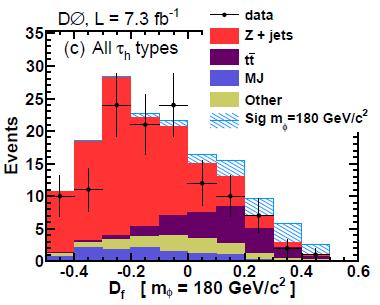
We report results from a search for neutral Higgs bosons produced in association with b quarks using data recorded by the D0 experiment at the Fermilab Tevatron Collider and corresponding to an integrated luminosity of 7.3 $fb^{-1}$. This production mode can be enhanced in several extensions of the standard model (SM) such as in its minimal supersymmetric extension (MSSM) at high tanBeta. We search for Higgs bosons decaying to tau pairs with one tau decaying to a muon and neutrinos and the other to hadrons. The data are found to be consistent with SM expectations, and we set upper limits on the cross section times branching ratio in the Higgs boson mass range from 90 to 320 $GeV/c^2$. We interpret our result in the MSSM parameter space, excluding tanBeta values down to 25 for Higgs boson masses below 170 $GeV/c^2$.The other two papers are in Antimatter Tevatron mystery gains ground, a great BBC's article. In particular BBC writes about Measurement of the anomalous like-sign dimuon charge asymmetry with 9 $fb^{-1}$ of $p \bar{p}$ collisions:
Subscribe to:
Posts (Atom)