In quantum mechanics a geometric phase, also called Berry phase, is a phase difference that a given physical system acquires during a cycle in which the system itself is under the action of an adiabatic process. This phase is linked to the geometric properties of the system itself (which is a simplification, but for our purposes there is no need to go into too much detail).
It was discovered independently by Shivaramakrishnan Pancharatnam in 1956(1), Hugh Christopher Longuet-Higgins(2) in 1958 and subsequently generalized by Michael Berry(3) in 1984. This phase, although geometric, has measurable physical effects, for example in an interference experiment. An example of a geometric phase is Foucault's pendulum.
The most famous version of this experiment, designed by Léon Foucault, dates back to 1851 when the French physicist, with the aim of showing the rotation of the Earth around its axis, suspended a ball of 28 kilograms of lead coated with brass over a surface of sand using a 67 meter cable hooked to the top of the dome of the Panthéon in Paris. The plane of the pendulum was observed to rotate clockwise at approximately 11.3 degrees per hour, completing a full circle in 31.8 hours. A more refined examination shows that after 24 hours there is a difference between the initial and final orientation of the trace left on Earth which is equal to

Showing posts with label cosmology. Show all posts
Showing posts with label cosmology. Show all posts
Our flat, fractal universe
In order to evaluate the curvature of a space, we drawn a triangle and measure its internal angles. If the value is approximately 180°, the space is flat; if it is greater than 180 degrees, the space is like a sphere; if less than 180°, the space is a kind of saddle. To evaluate the curvature of a space, however, we need to find sufficiently large triangles: if we try to draw a triangle on the ground, it will most likely be a flat triangle, but if we try to draw a triangle, from space, with the extremes of the Sicily, we will have a spherical triangle. Similarly, for the universe, we must determine a triangle as large as possible. At this point we could take three stars and draw a triangle: the only complication is finding three stars that are at the same time from the moment the cosmic expansion began, and this thing is not exactly easy to determine. This forces us to examine a widespread signal that we are certain is from the same period in the universe timeline: the cosmic microwave background.

Great number

Dirac, P. A. M. (1974). Cosmological models and the large numbers hypothesis. Proceedings of the Royal Society of London. A. Mathematical and Physical Sciences, 338(1615), 439-446. doi:10.1098/rspa.1974.0095
The other side of the matter
We know that exist a particular type of matter: the antimatter. Antimatter is composed by antiparticles. An antiparticle has the same mass as the corresponding particle but has opposite charge. And luckily for us antimatter is substantialy absent from our universe: indeed the interaction between matter and antimatter leads to the annihilation process, with the disappearance of particle and antiparticle and energy production. So, if in the universe there were the same amount of matter and antimatter, it would be filled exclusively with radiation. For this reason it is particularly interesting understand where this asymmetry originates: we know that would be a symmetry violation in some place and time of the universe, and the T2K experiment in Japan tested neutrinos' oscillations, in particular the oscillation from muonic to electronic neutrino. The results of ten years of data say that 90 neutrinos and only 15 antineutrinos were caught oscillating from muonic to electronic: different numbers mean violated symmetry.
The most interesting detail is that the experimental result doesn't exclude an interesting idea about an anti-universe that exists at the other side of the Big Bang.
The most interesting detail is that the experimental result doesn't exclude an interesting idea about an anti-universe that exists at the other side of the Big Bang.
Abe, K., Akutsu, R., Ali, A., Alt, C., Andreopoulos, C., Anthony, L., ... & Ashida, Y. (2020). Constraint on the Matter-Antimatter Symmetry-Violating Phase in Neutrino Oscillations. Nature volume 580, pages 339–344. doi:10.1038/s41586-020-2177-0
Boyle, L., Finn, K., & Turok, N. (2018). C P T-Symmetric Universe. Physical review letters, 121(25), 251301. doi:10.1103/PhysRevLett.121.251301
The road to reality
The discussion around what we know about the universe is in continuous development. If we take the infographic below, for example, we are faced with three possible scenarios: an accelerated expanding universe that will conclude is run in a big rip, in which the universe eventually turns completely black; a universe in which expansion is in balance with gravity, but nevertheless destined to make the skies of planets black and starless; a universe where expansion is blocked and reversed to a big crunch.

We know we don't know

The standard cosmological model, based on cosmic inflation(2) and on empirical constants that evaluate unknown physical quantities as dark matter and dark energy, although very well verified, has not yet passed the last step: the detection of gravitational waves in cosmic microwave background (CMB). One of the fundamental points of this model, but also of many of the surviving competing models, is the accelerated expansion of spacetime at speed greater than that of light which explains the flatness of the early universe.
This flatness emerges in particular when studying the cosmic microwave background, the residual energy of the initial expansion of spacetime. This radiation has come down to us from the point where it was produced, a little less than 14 billion years ago, crossing the whole universe. This means that in the signal detected there must also be gravitational lens effects(1) due to the amount of matter, usual and dark, present in the universe. These effects have long been known and calculated(4) and can already be seen in the image produced by Planck(5).
The great question about the Hubble constant
The Hubble-Lemaitre law is the mathematical formula bout the expanding universe. One of the collateral results of Einstein's theory of relativity was an expanding and non-static universe, a result that, in a first time, Einstein himself had disavowed. Yet various observations made in the second half of the 20s of the twentieth century instead confirmed the hypothesis of cosmic expansion(1, 2).
\[z = H_0 \frac{D}{c}\]
where $c$ is the speed of light, $H_0$ is the Hubble constant, while $z$ and $D$ are the light's redshift and the distance of the galaxy from the observer. The redshift, in particular, is due to the Doppler effect applied to electromagnetic waves. For example, when you hear the siren of an ambulance, it will seem to you stronger or weaker if approaching or moving away from your position. An electromagnetic wave, like light, instead will be closer to blue or red depending on whether it is closer to or away from the observer.
So, it has a certain importance to measure the redshift of the galaxies around us: evidently a null or little redshift was a clue to a static universe, otherwise we live in a dynamic universe, as you can see from the image present in the historical Hubble article(2):
So, it has a certain importance to measure the redshift of the galaxies around us: evidently a null or little redshift was a clue to a static universe, otherwise we live in a dynamic universe, as you can see from the image present in the historical Hubble article(2):
Abstract: The Universe at Lattice-Fields

Guido, G. and Filippelli, G. (2017) The Universe at Lattice-Fields. Journal of High Energy Physics, Gravitation and Cosmology, 3, 828-860. doi:10.4236/jhepgc.2017.34060.
We formulate the idea of a Universe crossing different evolving phases $U_k^*$ where in each phase one can define a basic field at lattice structure $U_k$ increasing in mass (Universe-lattice). The mass creation in $U_k$ has a double consequence for the equivalence "mass-space": Increasing gravity (with varying metric) and increasing space (expansion). We demonstrate that each phase is at variable metric beginning by open metric and to follow a flat metric and after closed. Then we define the lattice-field of intersection between two lattice fields of base into universe and we analyse the universe in the Nucleo-synthesis phase and in the that of recombination. We show that the phase is built on the intersection of the lattices of the proton and electron. We show $U_H$ [the intersection between proton's anch electron's lattices] to be at variable metric (open in the past, flat in the present and closed in the future). Then, we explain some fundamental aspects of this universe $U_H$: Hubble's law by creating the mass-space in it, its age (13.82 million of Years) as time for reaching the flat metric phase and the value of critic density. In last we talk about dark universe lattice, having hadronic nature, and calculating its spatial step and its density in present phase of [the universe].For some personal problems, I cannot add the LaTeX figures, so I uploaded them on researchgate.
The cosmological un-constant

A general line element and a general metric tensor are defined as functions of two parameters $\alpha$ and $\alpha'$. The related Einstein's field equations of a gravitational potential field in a vacuum, including parameter $\Lambda$, have been derived. The parameters $\alpha$ and $\alpha'$ are identified in a gravitational field by the solution of the Einstein's field equations. Parallel with this, it has been find out that the so‐called cosmological constant $\Lambda$, is not really constant, but a function of gravitational radius, $\Lambda = f(r)$. This discovery is very important, among the others, for cosmology. One of the consequences is the new form of the acceleration equation of the universe motion that can be attractive (negative) or repulsive (positive). According to the observations, the repulsive acceleration gives rise to accelerating expansion of the universe at the present time. The obtained solution of the diagonal line element can be applied in a very strong gravitational field. Besides, this solution gives the Ricci scalar equal to zero, $R=0$. This is in an agreement with the current observation that our universe is flat.
from Novakovic B.M., Novakovic D.B. & Novakovic A.B. (2004). The Cosmological Constant $\Lambda$ is not Really Constant but the Function of a Gravitational Radius, AIP Conference Proceedings, 718 133. DOI: 10.1063/1.1787318
Black holes and revelations: their large interiors
The 3d volume inside a spherical black hole can be defined by extending an intrinsic flat-spacetime characterization of the volume inside a 2-sphere. For a collapsed object, the volume grows with time since the collapse, reaching a simple asymptotic form, which has a compelling geometrical interpretation. Perhaps surprising, it is large. The result may have relevance for the discussion on the information paradox.
Marios Christodoulou & Carlo Rovelli (2014). How big is a black hole?, arXiv: http://arxiv.org/abs/1411.2854v2

A sphere $S$ on the event horizon bounds a spacelike hypersurface, a large portion of which coincides with an $r$ = constant hypersurface. We show this hypersurface with one dimension suppressed, and cut in the middle, omitting the long cylindrical part which gives the main contribution to its volume. We also illustrate the argument showing that most of the volume is contained in a region out of causal contact with matter that has advanced far into the black hole.
Ingemar Bengtsson & Emma Jakobsson (2015). Black holes: Their large interiors, arXiv: http://arxiv.org/abs/1502.01907v1
Alan Guth, eternal inflation and the multiverse
At the beggining of October, Alan Guth was at the workshop Fine-Tuning, Anthropics and the String Landscape at Madrid, and he concluded his talk with the following slide:
 The complete talk, without question time, follows:
Stephen Hawking and the (cosmological) Riemann's zeta function

This paper describes a technique for regularizing quadratic path integrals on a curved background spacetime. One forms a generalized zeta function from the eigenvalues of the differential operator that appears in the action integral. The zeta function is a meromorphic function and its gradient at the origin is defined to be the determinant of the operator. This technique agrees with dimensional regularization where one generalises ton dimensions by adding extra flat dimensions. The generalized zeta function can be expressed as a Mellin transform of the kernel of the heat equation which describes diffusion over the four dimensional spacetime manifold in a fith dimension of parameter time. Using the asymptotic expansion for the heat kernel, one can deduce the behaviour of the path integral under scale transformations of the background metric. This suggests that there may be a natural cut off in the integral over all black hole background metrics. By functionally differentiating the path integral one obtains an energy momentum tensor which is finite even on the horizon of a black hole. This energy momentum tensor has an anomalous trace.Hawking used the following version for the zeta: \[\zeta (s) = \sum_n \lambda_n^{-s}\] where $\lambda_n$ are the eigenvalues of a given operator $A$, constructed using the background fields of the spacetime. In four dimensions the function will converge for $\Re (s) > 2$.
About the use of the Riemann's zeta function in physics, you could also read Effective Lagrangian and energy-momentum tensor in de Sitter space
Hawking S.W. (1977). Zeta function regularization of path integrals in curved spacetime, Communications in Mathematical Physics, 55 (2) 133-148. DOI: 10.1007/BF01626516 (pdf)
The infinite inflation and the end of time
I published this post some years ago (archived version), but for unilateral decision of the online publisher, it is deleted, so I decide to recover it.
In the early years of the 3rd millennium there was a discussion about eternal inflation. This theoric ipothesis was introduce by Alan Guth and other physicists. In particular you can read Guth's paper Eternal Inflation(1):The basic workings of inflationary models are summarized, along with the arguments that strongly suggest that our universe is the product of inflation. It is argued that essentially all inflationary models lead to (future-)eternal inflation, which implies that an infinite number of pocket universes are produced. Although the other pocket universes are unobservable, their existence nonetheless has consequences for the way that we evaluate theories and extract consequences from them. The question of whether the universe had a beginning is discussed but not definitively answered. It appears likely, however, that eternally inflating universes do require a beginning.We have a lot of observations that confirms not only the big bang theory, but also the inflation period: in some time after the first expansion of the universe, there is a faster expansion of space time. The most important observation that supports inflation is the anisotropy of the cosmic background radiation (we could add also the absence of magnetic monopole...).
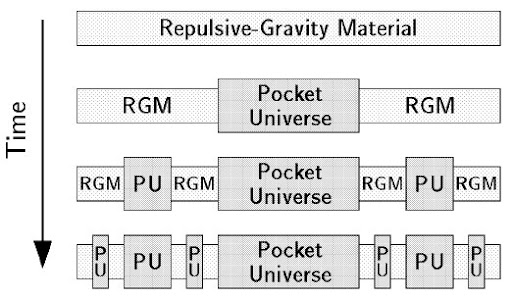
The background of eternal inflation ipothesis is the existence of repulsive-gravity material, that is unstable and decay with an exponential law (like any radiactive atom). In every decay process the volume of repulsive-gravity material grow instead decrease and prodece a never ending series of pocket universes(1, 2):
Super-Nobel in Physics 2011

The supernova of 1604 caused even more excitement than Tycho's because its appearance happened to coincide with a so-called Great Conjunction or close approach of Jupiter, Mars and Saturn.(1)The Galilei's discover was revolutionary for one important reason:
Galileo's observations and those made elsewhere in Italy and in Northern Europe indicated that it was beyond the Moon, in the region where the new star of 1572 had appeared. The appearance of a new body outside the Earth-Moon system had challenged the traditional belief, embodied in Aristotle's Cosmology, that the material of planets was unalterable and that nothing new could occur in the heavens.(1)About the new star
Galileo states that [it] was initially small but grew rapidly in size such as to appear bigger than all the stars, and all planets with the exception of Venus.(1)We can confrount the observation with modern definitions:
Novae are the result of explosions on the surface of faint white dwarfs, caused by matter falling on their surfaces from the atmosphere of larger binary companions. A supernova is also a star that suddenly increases dramatically in brightness, then slowly dims again, eventually fading from view, but it is much brighter, about ten thousand times more than a nova.(1)These dramatical events became soon a good tools in order to observe the expansion of the universe:
Type Ia supernovae are empirical tools whose precision and intrinsic brightness make them sensitive probes of the cosmological expansion.(5)And observing a series of supernovae the team of Brian Schmidt (1967) and Adam Riess (1969) in 1998(3) and the team of Saul Perlmutter (1959) in 1999(4) found an important consmological observation: Universe is accelerating!
Subscribe to:
Posts (Atom)