Showing posts with label cosmic inflation. Show all posts

We know we don't know

A few days ago on Nature Astronomy it was published a paper by a team of italian researchers with an unequivocal title: Planck evidence for closed Universe and a possible crisis for cosmology(6). We can consider it as one of the first scientific articles that seriously takes into consideration a situation that it is becoming increasingly pressing: a crisis in cosmology.
The standard cosmological model, based on cosmic inflation(2) and on empirical constants that evaluate unknown physical quantities as dark matter and dark energy, although very well verified, has not yet passed the last step: the detection of gravitational waves in cosmic microwave background (CMB). One of the fundamental points of this model, but also of many of the surviving competing models, is the accelerated expansion of spacetime at speed greater than that of light which explains the flatness of the early universe.
This flatness emerges in particular when studying the cosmic microwave background, the residual energy of the initial expansion of spacetime. This radiation has come down to us from the point where it was produced, a little less than 14 billion years ago, crossing the whole universe. This means that in the signal detected there must also be gravitational lens effects(1) due to the amount of matter, usual and dark, present in the universe. These effects have long been known and calculated(4) and can already be seen in the image produced by Planck(5).

Alan Guth, eternal inflation and the multiverse

http://t.co/CnvvOY0mAI about #AlanGuth #multiverse #CosmicInflation #icep2014
At the beggining of October, Alan Guth was at the workshop Fine-Tuning, Anthropics and the String Landscape at Madrid, and he concluded his talk with the following slide:
The complete talk, without question time, follows:

Waiting for the beginning

Following a draft published on arXiv a couple of weeks ago, the BICEP2's observations could be explained not only with the cosmic inflation, but also with another mechanism:
The recent claimed observation of primordial gravitational waves provides a dramatic new empirical window on the early universe. In particular, it provides the opportunity, in principle, to de nitively test the inflationary paradigm, and to explore the speci c physics of inflationary models. However, while there is little doubt that inflation at the Grand Unfi ed Scale is the best motivated source of such primordial waves, it is important to demonstrate that other possible sources cannot account for the current BICEP2 data before definitely claiming Inflation has been proved.
A possible contribution to BICEP2's signal could be given by a self ordering scalar field:
Finally we note that while current data cannot de nifitively rule out a SOSF transition as the source of gravitational waves, it nevertheless does imply that the source for such waves is at, or near the Grand Uni ed Scale. Thus, it allows an exploration of physics at a scale far larger than we can currently constrain at terrestrial experiments. This will be very important for constraining physics beyond the standard model, whether or not inflation is responsible for the entire BICEP2 signal, even though existing data from cosmology is strongly suggestive that it does.
About the SOSF I found some interesting paper on arXiv:
A Nearly Scale Invariant Spectrum of Gravitational Radiation from Global Phase Transitions, Probing the Gravitational Wave Signature from Cosmic Phase Transitions at Different Scales, and Gravitational waves from self-ordering scalar fields.
via AstronomicaMens, The Physics arXiv Blog

A blink of an eye

Almost 14 billion years ago, the universe we inhabit burst into existence in an extraordinary event that initiated the Big Bang. In the first fleeting fraction of a second, the universe expanded exponentially, stretching far beyond the view of our best telescopes. All this, of course, was just theory.
Researchers from the BICEP2 collaboration today announced the first direct evidence for this cosmic inflation. Their data also represent the first images of gravitational waves, or ripples in space-time. These waves have been described as the "first tremors of the Big Bang." Finally, the data confirm a deep connection between quantum mechanics and general relativity.
(from the press release)
In physics, gravitational waves are ripples in the curvature of spacetime that propagate as a wave, travelling outward from the source. Predicted in 1916 by Albert Einstein to exist on the basis of his theory of general relativity, gravitational waves theoretically transport energy as gravitational radiation. Sources of detectable gravitational waves could possibly include binary star systems composed of white dwarfs, neutron stars, or black holes. The existence of gravitational waves is a possible consequence of the Lorentz invariance of general relativity since it brings the concept of a limiting speed of propagation of the physical interactions with it. Gravitational waves cannot exist in the Newtonian theory of gravitation, in which physical interactions propagate at infinite speed.
(from Wikipedia) Cosmic inflation was introduced by Alan Guth and Andrei Linde in 1981:
One of the intriguing consequences of inflation is that quantum fluctuations in the early universe can be stretched to astronomical proportions, providing the seeds for the large scale structure of the universe. The predicted spectrum of these fluctuations was calculated by Guth and others in 1982. These fluctuations can be seen today as ripples in the cosmic background radiation, but the amplitude of these faint ripples is only about one part in 100,000. Nonetheless, these ripples were detected by the COBE satellite in 1992, and they have now been measured to much higher precision by the WMAP satellite and other experiments. The properties of the radiation are found to be in excellent agreement with the predictions of the simplest models of inflation.
(from MIT)
So our universe is born after a quantum blink of an eye, or like a solution of the equation of everything.
In the following a storify with a collection of link about one of the most important discovery of the... universe!

The infinite inflation and the end of time

by @ulaulaman about #cosmology #mathematics #inflation #Hawking #AlanGuth
I published this post some years ago (archived version), but for unilateral decision of the online publisher, it is deleted, so I decide to recover it.
In the early years of the 3rd millennium there was a discussion about eternal inflation. This theoric ipothesis was introduce by Alan Guth and other physicists. In particular you can read Guth's paper Eternal Inflation(1):
The basic workings of inflationary models are summarized, along with the arguments that strongly suggest that our universe is the product of inflation. It is argued that essentially all inflationary models lead to (future-)eternal inflation, which implies that an infinite number of pocket universes are produced. Although the other pocket universes are unobservable, their existence nonetheless has consequences for the way that we evaluate theories and extract consequences from them. The question of whether the universe had a beginning is discussed but not definitively answered. It appears likely, however, that eternally inflating universes do require a beginning.
We have a lot of observations that confirms not only the big bang theory, but also the inflation period: in some time after the first expansion of the universe, there is a faster expansion of space time. The most important observation that supports inflation is the anisotropy of the cosmic background radiation (we could add also the absence of magnetic monopole...).
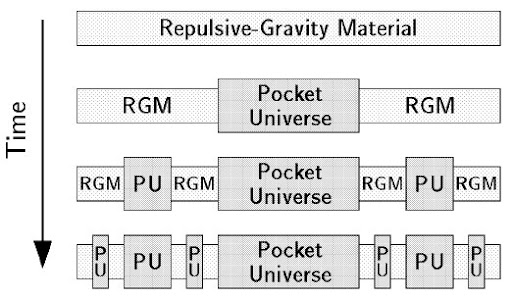
The background of eternal inflation ipothesis is the existence of repulsive-gravity material, that is unstable and decay with an exponential law (like any radiactive atom). In every decay process the volume of repulsive-gravity material grow instead decrease and prodece a never ending series of pocket universes(1, 2):
In Cosmology from the Top Down, a talk presented at Davis Inflation Meeting in 2003, Stephen Hawking speak about some criticism on eternal inflation: