Showing posts with label dark matter. Show all posts

Dark scent


The hand of creation by John Byrne from Green Lantern: Ganthet's Tale
The XENON1T experiment at Gran Sasso's laboratories in Italy is a liquid xenon detector designed for serach of the mysterious dark matter. About one year ago researchers observed an excess of events: 53 more than the 232 predicted(1).
There are several explanations: an unexpected noise' source; the passage of some axions, an hypothetical particle predicted by Roberto Peccei and Helen Quinn in 1977; some neutrinos that interact with matter in a new way.
Or dark matter's traces(2). There are two new articles suggesting this; in particular the second suggests that the detected excess in XENON1T is dued by chameleons(3).
The chameleon is an(other) hypothetical particle proposed in 2003 by Justin Khoury and Amanda Weltman, that couples to matter more weakly than gravity, and so a candidate for dark matter. It has a variable mass, so the hypothetical fifth force mediated by the chameleons can evade the constraints deduced by experiments on the equivalence principle. In this way chameleons could drive the observed acceleration of the universe's expansion, but it's very difficult to verify experimentally.
  1. XENON collaboration. (2020). Excess electronic recoil events in XENON1T. Physical Review D, 102(7). doi:10.1103/PhysRevD.102.072004 ↩︎
  2. Aboubrahim, A., Klasen, M., & Nath, P. (2021). Xenon-1T excess as a possible signal of a sub-GeV hidden sector dark matter. Journal of High Energy Physics, 2021(2), 1-21. doi:10.1007/JHEP02(2021)229 ↩︎
  3. Vagnozzi, S., Visinelli, L., Brax, P., Davis, A. C., & Sakstein, J. (2021). Direct detection of dark energy: the XENON1T excess and future prospects. Physical Review D, 104(6). doi:10.1103/PhysRevD.104.063023 ↩︎

Uchuu: Universes' creator

If you are a superheroes' comics readers, you probably know All-Star Superman by Grant Morrison and Frank Quitely (if you want, I could publish a review of this comic). At some point in the story, Superman designs a small cubic universe to see what would happen on a planet like Earth without his presence. The development of intelligent life was also included in the Superman's simulation, but in essence even those of astronomers are structured in the same way: a cube of space of finite dimensions whose evolution is driven by a network of dark matter and dark energy.
At the end of the july 2021 it was realased Uchuu, presented as a suite of large high-resolution cosmological N-body simulations, in practice, a simulation that shows the evolution of dark matter structures in a cube of 9.63 billion light years on each side and made up of 2.1 trillion particles.
Uchuu's main goal is to shed light on the dark matter halos surrounding galaxies, but the researchers think that another field of use for their simulation is the study of gravitational lenses.
In any case, it is a tool that could be very useful for improving the algorithms generally used in astronomy to process the data collected by instruments such as satellites and telescopes.
Ishiyama, T., Prada, F., Klypin, A. A., Sinha, M., Metcalf, R. B., Jullo, E., ... & Vega-Martínez, C. A. (2021). The Uchuu simulations: Data Release 1 and dark matter halo concentrations. Monthly Notices of the Royal Astronomical Society, 506(3), 4210-4231. doi:10.1093/mnras/stab1755 (arXiv)
Read also:
Skies & Universes
Uchuu project on Git-Hub

Planck results, ATLAS and the dark matter

http://t.co/jJxD8rhCr6 by @ulaulaman about #Planck, #ATLAS, #DarkMatter at #LHC
The last issue of Astronomy & Astrophysics (that it's free) is devoted to the Planck 2013 results:
This collection of 31 articles presents the initial scientific results extracted from this first Planck dataset, which measures the cosmic microwave background (CMB) with the highest accuracy to date. It provides major new advances in different domains of cosmology and astrophysics.
In the first paper there is an overview of 2013 science results, and we can read:
The Universe observed by Planck is well-fit by a six parameter, vacuum-dominated, cold dark matter (ACDM) model, and we provide strong constraints on deviations from this model.
But, in the meanwhile, ATLAS published a preprint about the quest of the dark matter in LHC:
The data are found to be consistent with the Standard Model expectations and limits are set on the mass scale of effective field theories that describe scalar and tensor interactions between dark matter and Standard Model particles. Limits on the dark-matter--nucleon cross-section for spin-independent and spin-dependent interactions are also provided. These limits are particularly strong for low-mass dark matter. Using a simplified model, constraints are set on the mass of dark matter and of a coloured mediator suitable to explain a possible signal of annihilating dark matter.
Tommaso Dorigo, examining ATLAS' results, concludes:
the ATLAS search increases significantly the sensitivity with respect to past searches, but no signal is found. As attractive as DM existence is as an economical explanation of a wealth of cosmological observations, the nature of dark matter continues to remain unknown.

via phys.org

The void theory

On tumblr, one of my reader, frankietwohats, ask me the following question:
Can I ask you a random question? I can't remember the name of a theory that argued that the universe wasn't expanding, but instead was stretching. Do you happen to know of it/it's name? It came up in conversation today (well, universe expansion did) and I want to look into it more.
I don't know if this is the theory that you intend, but after a briefly research on Google, i find th Void theory. About it, Esther Inglis-Arkell writes on io9:
There was a time that the earth was considered the center of the universe. Then it got knocked out of the way by the sun, and ever since then the astronomer's mantra was, "We are nothing special." The part of the universe the earth resides in can't be any different than any other part. It's not unique, or remarkable, or even out of the ordinary. Void Theory contradicts all that. Instead of sitting in a typical part of the universe, the earth sits in an unusually empty part; a void. The universe isn't expanding due to some mysterious force. It's just that when light comes from a denser part of the universe and trips across the void, it is altered to make it look like the universe is expanding. Since this exansion is the same when observed from any part of the earth, the earth has to be roughly at the center of this void. Suddenly, the observable universe is geocentric again.
But... what is the void theory?

This diagram reveals changes in the rate of expansion since the universe's birth 15 billion years ago. The more shalow the curve, the faster the rate of expansion. The curve changes noticeably about 7.5 billion years ago, when objects in the universe began flying apart as a faster rate. Astronomers theorize that the faster expansion rate is due to a mysterious, dark force that is pulling galaxies apart.
First of all, following Clifton, Ferreira and Land(1), we must remember that our picture of the universe is based on the following two principles: the spacetime is dynamical, obeying to the Einstein's equations; the Universe is homogeneous and isotropic on large scales, that is a generalisation of the Copernican Principle that the Earth is not in a central, specially favored position.
Now, the exact solution of Einstein's equations was provided by Lemaitre-Tolman-Bondi spacetime \[\text{d} s^2 = -\text{d} t^2 + \frac{Y'^2}{1-K} \text{d} r^2 + Y^2 \text{d} \Omega\] In this model there are four free parameters: the density at the origin, the density and radius at the midpoint, and the radius at which we match to Einstein-de Sitter spacetime(2). Instead the void model:
is completely specfied by the radial profile, the Hubble rate at the void centre today, $H_0$, the radiation density today, which is fixed by the CMB mean temperature, $T_0 = 2.725 K$, and the baryon fraction $f_b = \frac{\rho_b}{\rho_m}$. Outside the void we asymptote to EdS.

The curvature for three different types of voids

Italians in space

DAMA mission logo

DAMA mission's logo is designed by an italian middle school student, and mission name is choiced by another young pupil using the first two letters ofthe words dark matter.
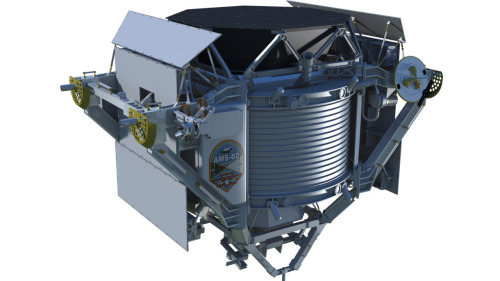
The mission man is Roberto Vittori: he'll use AMS-02. Using this device, he will detect dark matter and antimatter by observing the cosmic rays, helping us hopefully to better understand the origin and structure of the Universe.
Roberto will act also some experiments in life science, technology, medicine, biology and material science.

From ESA's pdf I extract some quotes about AMS:
AMS is embarking on a mission to explore distant and
uncharted realms of our Universe, where answers to some longstanding questions in particle physics and cosmology may be revealed and unexpected phenomena may be discovered.
Mission's keywords are cosmic rays, antimatter, dark matter, dark energy.
Cosmic rays are composed by radiation and stable particles from stars, but when they arrive to our planet, they interact with atmosphere. So it is need to use a detector in space, and astronomers and particle physicists are eagerly awaiting the data.
Antimatter is, in a very simple picture, same to the matter but with opposed charge, and is more unstable.
AMS will search for antimatter to the edge of the observable universe.
Finally, according to theories and indirect observations, we know to... unknow 95% of the universe! Experiment was projected by prof.Ting.
Prof. Ting's experiment will increase the sensitivity of the search by between a thousand and a million times, revealing a totally different domain by either finding the neutralino or revealing something else. AMS-02 might also detect a new, exotic form of matter predicted by scientists: a very heavy elementary particle dubbed 'strangelet'.

Another important event is the presence on International Space Station of two italians, Roberto Vittori, who arrived with STS-134 mission. And on ISS there is Paolo Nespoli, who publishes his spectacular photos on flickr.
A great event for all Italian poeple!

(via ESA)