De mundi systemate

by @ulaulaman about #IsaacNewton #physics #gravity
I published this post some years ago (archived version), but for unilateral decision of the online publisher, it is deleted, so I decide to recover it.
De mundi systemate
It's the third pard o Newton's Philosophiae Naturalis Principia Mathematica, one of the most famous physics tractatus (latin world to treatise). In 2010 Dave Richeson proposes An amazing paragraph from Euler's Introductio, a wonderful post in which he extraxts some Euler's quotes from Introductio in analysin infinitorum (Introduction to analysis of the infinite). So, because I'm working on a learning project about gravity, I decide to propose an analouge post about De mundi systemate (On worlds' system). For english version of the following Newton's quotes I'll ask help to Andrew Motte.
We began with Propositio II (Proposition II):

The infinite inflation and the end of time

by @ulaulaman about #cosmology #mathematics #inflation #Hawking #AlanGuth
I published this post some years ago (archived version), but for unilateral decision of the online publisher, it is deleted, so I decide to recover it.
In the early years of the 3rd millennium there was a discussion about eternal inflation. This theoric ipothesis was introduce by Alan Guth and other physicists. In particular you can read Guth's paper Eternal Inflation(1):
The basic workings of inflationary models are summarized, along with the arguments that strongly suggest that our universe is the product of inflation. It is argued that essentially all inflationary models lead to (future-)eternal inflation, which implies that an infinite number of pocket universes are produced. Although the other pocket universes are unobservable, their existence nonetheless has consequences for the way that we evaluate theories and extract consequences from them. The question of whether the universe had a beginning is discussed but not definitively answered. It appears likely, however, that eternally inflating universes do require a beginning.
We have a lot of observations that confirms not only the big bang theory, but also the inflation period: in some time after the first expansion of the universe, there is a faster expansion of space time. The most important observation that supports inflation is the anisotropy of the cosmic background radiation (we could add also the absence of magnetic monopole...).
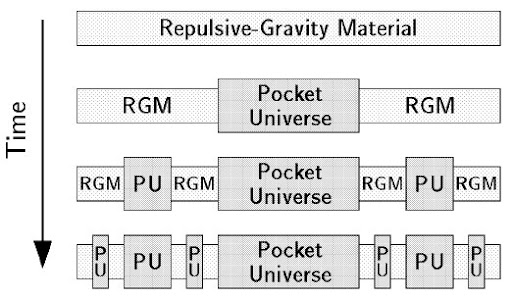
The background of eternal inflation ipothesis is the existence of repulsive-gravity material, that is unstable and decay with an exponential law (like any radiactive atom). In every decay process the volume of repulsive-gravity material grow instead decrease and prodece a never ending series of pocket universes(1, 2):
In Cosmology from the Top Down, a talk presented at Davis Inflation Meeting in 2003, Stephen Hawking speak about some criticism on eternal inflation:

The Universe in a glass of wine

by @ulaulaman about #RichardFeynman #physics #universe #wine
Once upon a time, Richard Feynman telled a story about the universe and a glass of wine:
A poet once said, "The whole universe is in a glass of wine." We will probably never know in what sense he said that, for poets do not write to be understood. But it is true that if we look in glass of wine closely enough we see the entire universe.
There are the things of physics: the twisting liquid which evaporates depending on the wind and weather, the reflections in the glass, and our imagination adds the atoms. The glass is a distillation of the earth’s rocks, and in its composition we see the secrets of the universe’s age, and the evolution of the stars. What strange array of chemicals are in the wine? How did they come to be? There are the ferments, the enzymes, the substrates, and the products. There in wine is found the great generalization: all life is fermentation. Nobody can discover the chemistry of wine without discovering the cause of much disease. How vivid is the claret, pressing its existence into the consciousness that watches it!
If in our small minds, for some convenience, divide this glass of wine, this universe, into parts - physics, biology, geology, astronomy, psychology, and so on - remember that nature does not know it! So let us put it all back together, not forgetting ultimately what it is for. Let us give one more final pleasure: drink it and forget it all!
You can find the text and the audio on the site of Efthymios Kallos, but... The Universe in a glass of wine is also an artist exposition: see, for example, the Life cycle of a star by Natalie Kay Thatcher. And it is interesting that Natalie realized two comics about Feynman: How to start a Feynman (preview), and the Feynman zine (review by Pete Willis) about the universe and the glass of wine:

Neural networks and astronomy

by @ulaulaman about #astronomy #mathematics #NeuralNetwork #Saturn
I published this post some years ago (archived version), but for unilateral decision of the online publisher, it is deleted, so I decide to recover it.
Neural network is one of the most powered method to analize data. It can be use in most research subject, for example in astronomy: in this case, we can use NNs to examine astronomical images or also the red shift effect. For example, in 2003 Jorge Núñez (Universitad de Barcelona) and Jorge Llacer (EC Engineering Consultants LLC) published a paper(1) in which they describe the develop of an algorithm to study astronomical image segmentation that uses a self-organizing neural network as basis. In their work, the scientists examine the separation between some stars and also a Saturn's image: the alghoritm seems quite robust against noise and fragmentation.
In the same year, a group of italian astronomers published a review of the models used in astronomy and examined some data used by AstroNeural collaboration. Finally in 2004 a collaboration between researchers in Italy, Germany and France perform an application of NNs to redshift calculations(3).
Now you can quest: What is a neural network?

Pulsars to detect Earth's motion

by @ulaulaman about #astronomy #pulsars #mathematics #earth
I published this post some years ago (archived version), but for unilateral decision of the online publisher, it is deleted, so I decide to recover it now.

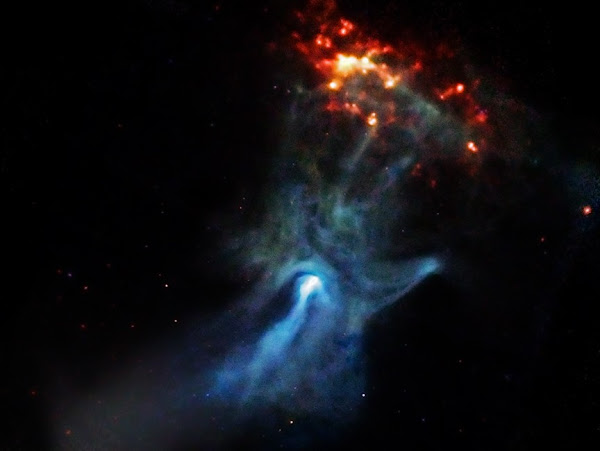
A Pulsar's Hand P. Slane et. al (Apod)

We all known the story of the little green men: in 1967 Jocelyn Bell and Antony Hewish discovered a strange, regular cosmic signal, a periodic bep. They consulted Fred Hoyle, astronomers and sci-fi writer, and he understood that the signal was emitted by a neutrons' star, a pulsar. An italian research team, composed by Matteo Luca Ruggiero, Emiliano Capolongo, Angelo Tartaglia, published the following paper, Pulsars as celestial beacons to detect the motion of the Earth (arXiv). In their paper, researchers propose to apply some relativistic mathematical tools to calculate Earth position using pulsars signals.