Showing posts with label earth. Show all posts

Earth's albedo and global warming

It's actually quite concerning. For some time, many scientists had hoped that a warmer Earth might lead to more clouds and higher albedo, which would then help to moderate warming and balance the climate system. But this shows the opposite is true.
In this way Edward Schwieterman(1) commented the result of a new paper about the Earth's climate. But first of all we must say what is albedo:
(...) is the measure of the diffuse reflection of solar radiation out of the total solar radiation and measured on a scale from 0, corresponding to a black body that absorbs all incident radiation, to 1, corresponding to a body that reflects all incident radiation.
Now, a black body, an idealized opaque, non-reflective body, emits a thermal electromagnetic radiation that we could estimate also for the Earth. If we modelled it as a perfect black body, we find a temperature about 254.356 K, or -18.8 °C. But if we consider also, for example, the albedo, we can find a temperature of 245 K for albedo equals to 0.4, and a temperature of 255 K for albedo equals to 0.3. So, if the albedo decreases, Earth's temperature increases. And this is exactly what the researchers found.
Goode, P. R., Pallé, E., Shoumko, A., Shoumko, S., Montañes‐Rodriguez, P., & Koonin, S. E. (2021). Earth's Albedo 1998–2017 as Measured From Earthshine. Geophysical Research Letters, 48(17), e2021GL094888. doi:10.1029/2021GL094888

  1. Earth is dimming due to climate change ↩︎

Total's responses to global warming

Building upon recent work on other major fossil fuel companies, we report new archival research and primary source interviews describing how Total responded to evolving climate science and policy in the last 50 years. We show that Total personnel received warnings of the potential for catastrophic global warming from its products by 1971, became more fully informed of the issue in the 1980s, began promoting doubt regarding the scientific basis for global warming by the late 1980s, and ultimately settled on a position in the late 1990s of publicly accepting climate science while promoting policy delay or policies peripheral to fossil fuel control. Additionally, we find that Exxon, through the International Petroleum Industry Environmental Conservation Association (IPIECA), coordinated an international campaign to dispute climate science and weaken international climate policy, beginning in the 1980s. This represents one of the first longitudinal studies of a major fossil fuel company's responses to global warming to the present, describing historical stages of awareness, preparation, denial, and delay.
Bonneuil, C., Choquet, P. L., & Franta, B. (2021). Early warnings and emerging accountability: Total’s responses to global warming, 1971–2021. Global Environmental Change, 102386. doi:10.1016/j.gloenvcha.2021.102386

Updates from outer space: from Earth to K2-18 b

There are some interesting news about the research of exoplanets, but the first step starting from our planet, the Earth. Indeed, Evelyn Macdonald and Nicolas Cowan used the satellite Scicast to detect the transit spectrum of our planet. The idea is to deduce the atmosphere composition, obtaining the Earth's organic signature, and in this way data to confront with exoplanets transit spectrum.
Macdonald, E. J., & Cowan, N. B. (2019). An empirical infrared transit spectrum of Earth: opacity windows and biosignatures. Monthly Notices of the Royal Astronomical Society, 489(1), 196-204. doi:10.1093/mnras/stz2047
About two weeks after the pubblication of the previous paper, an international team of astronomers have discovered water vapor in the atmosphere of K2-18 b, an exoplanet that orbit in the habitable zone of the red dwarf K2-18. While it was initially considered a mini-Neptune on its 2015 discovery, the improved data on K2-18b has classified it as a super-Earth, although its size and density make it unlikely to be composed entirely of rocky iron and silicates.
Tsiaras A., Waldmann I. P., Tinetti G., Tennyson J., Yurchenko S. N. (2019). Water vapour in the atmosphere of the habitable-zone eight-Earth-mass planet K2-18 b. Nature Astronomy. doi:10.1038/s41550-019-0878-9

Bioplastic from weaver's broom

At the end of 1980s the researcher Catia Bastioli developed a new bioplastic, Mater-Bi, using corn(1). Since 1989, there were developed a lot of bioplastic, for example the polymer poly(lactic acid)(2) or the broom fibers:
Fallico, C., Troisi, S., Molinari, A., and Rivera, M. F.: Characterization of broom fibers for PRB in the remediation of aquifers contaminated by heavy metals, Biogeosciences, 7, 2545-2556, doi:10.5194/bg-7-2545-2010, 2010
The present level of pollution, increasingly involving ground waters, constitutes a serious risk to the environment and also to human health. Therefore the remediation of saturated and unsaturated soils to remove pollutant materials is more and more frequently required. In the present paper, the possibility of removing heavy metals by permeable reactive barrier (PRB) from the groundwater carried out specifically with broom fibers, is investigated.
Once shown the economic benefits deriving from the use of this plant, a hydraulic characterization of the broom fiber mass was performed, determining the permeability and the porosity in correspondence to different levels of compactness of the fibers.
Having verified the effectiveness of removal of some heavy metals by these fibers, the results of some experiments, carried out in the laboratory for this purpose, are shown. These experiments were carried out utilizing broom fibers obtained in different ways and, limitedly to the considered pollutants, showed the high capability of these fibers to reduce their concentrations. The best results were obtained for the broom fibers extracted by a particular chemical-physical process.
Moreover, the behaviour of this fiber with time was investigated, determining the kinetic constant of degradation.
Gabriele, Bartolo, Teresa Cerchiara, Giuseppe Salerno, Giuseppe Chidichimo, Mabel Valeria Vetere, Cosimo Alampi, Maria Caterina Gallucci, Carmela Conidi, and Alfredo Cassano. "A new physical–chemical process for the efficient production of cellulose fibers from Spanish broom (Spartium junceum L.)." Bioresource technology 101, no. 2 (2010): 724-729. doi:10.1016/j.biortech.2009.08.014 (sci-hub)
A novel and efficient method for the extraction of cellulose fibers from Spanish broom (Spartium junceum L.) is presented. The method is based on the sequential combination between an initial chemical stage (alkaline digestion) and a subsequent physical–chemical stage, consisting of compression with hot air in an autoclave followed by rapid decompression (DiCoDe process, digestion–compression–decompression). The alkaline mother liquor deriving from the initial digestion step can be conveniently recycled after centrifugation followed by ultrafiltration. The process is characterized by the production of fibers with excellent physical–chemical properties, such as high mechanical resistance and high elasticity, and rapid production times. The fibers obtained after the DiCoDe process can be further softened and whitened by means of enzymatic digestion.
Fibers were morphologically characterized by scanning electron microscopy (SEM), while their composition and physical–chemical properties were determined by conventional methods, including colorimetry, TAPPI protocols, IR spectroscopy, and X-ray diffractometry.
Cassano, Roberta, Sonia Trombino, Ermelinda Bloise, Rita Muzzalupo, Francesca Iemma, Giuseppe Chidichimo, and Nevio Picci. "New broom fiber (Spartium junceum L.) derivatives: preparation and characterization." Journal of agricultural and food chemistry 55, no. 23 (2007): 9489-9495. doi:10.1021/jf071711k (sci-hub)
In the past decade interest in biopolymers has increased. Attempts were made to prepare new composite systems from biopolymers by binding different synthetic polymers to a biopolymer backbone. This paper reports the synthesis and characterization of derivatized broom fibers to prepare composites with either degradability or fireproofing properties. Synthetic strategies are described for the introduction of polymerizable functional groups or fluorine atoms on the glucose of cellulose chains of broom. The fibers containing polymerizable groups were copolymerized with dimethylacrylamide and styrene and, after that, investigated by optical polarizing microscopy (OPM) and scanning electron microscopy analysis (SEM). The materials containing fluorine were submitted to thermogravimetric analysis (TGA) and differential scanning calorimetry (DSC) for the purpose of verifying the fireproofing. Such derivatized biomaterials could be successfully used for applications in agriculture and in the packaging area.

(1) Bastioli, Catia. "Properties and applications of Mater-Bi starch-based materials." Polymer Degradation and Stability 59.1-3 (1998): 263-272. doi:10.1016/S0141-3910(97)00156-0 (sci-hub)
(2) Karamanlioglu, Mehlika, Richard Preziosi, and Geoffrey D. Robson. "Abiotic and biotic environmental degradation of the bioplastic polymer poly (lactic acid): A review." Polymer Degradation and Stability (2017). doi:10.1016/j.polymdegradstab.2017.01.009 (sci-hub)

Alexander Gerst's timelapse

Watch Earth roll by through the perspective of ESA astronaut Alexander Gerst in this six-minute timelapse video from space. Combining 12 500 images taken by Alexander during his six-month Blue Dot mission on the International Space Station this Ultra High Definition video shows the best our beautiful planet has to offer.
Marvel at the auroras, sunrises, clouds, stars, oceans, the Milky Way, the International Space Station, lightning, cities at night, spacecraft and the thin band of atmosphere that protects us from space.
Often while conducting scientific experiments or docking spacecraft Alexander would set cameras to automatically take pictures at regular intervals. Combining these images gives the timelapse effect seen in this video.
Watch the video in 4K resolution for the best effect and find out more about Alexander Gerst's Blue Dot mission.

Inge Lehmann: the core of the Earth

http://t.co/gCOlKccELA about #IngeLehmann #EarthCore #theCore #geophysics
Inge Lehmann was a Danish seismologist and geophysicist. Using seismic data, she discovered the inner solid core of the Earth with some physical properties distinct from the outer liquid core:
No rays emerged at epicentral distances between 112° and 154°. I then placed a smaller core inside the first core and let the velocity in it be larger so that a reflection would occur when the rays through the larger core met it. After a choice of velocities in the inner core was made, a time curve was obtained, part of which appeared in the interval where there had not been any rays before. The existence of a small solid core in the innermost part of the earth was seen to result in waves emerging at distances where it had not been possible to predict their presence.

Lehmann, I. (1987). Seismology in the days of old Eos, Transactions American Geophysical Union, 68 (3) DOI: 10.1029/EO068i003p00033-02 (full paper)
Read also: Bolt, B. (1994). Inge Lehmann Physics Today, 47 (1) DOI: 10.1063/1.2808386

Pulsars to detect Earth's motion

by @ulaulaman about #astronomy #pulsars #mathematics #earth
I published this post some years ago (archived version), but for unilateral decision of the online publisher, it is deleted, so I decide to recover it now.

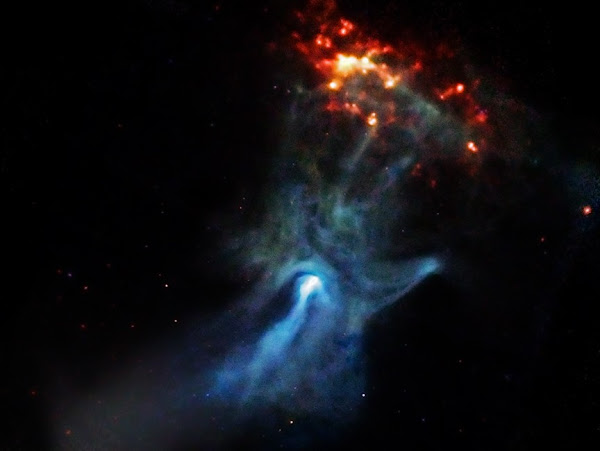
A Pulsar's Hand P. Slane et. al (Apod)

We all known the story of the little green men: in 1967 Jocelyn Bell and Antony Hewish discovered a strange, regular cosmic signal, a periodic bep. They consulted Fred Hoyle, astronomers and sci-fi writer, and he understood that the signal was emitted by a neutrons' star, a pulsar. An italian research team, composed by Matteo Luca Ruggiero, Emiliano Capolongo, Angelo Tartaglia, published the following paper, Pulsars as celestial beacons to detect the motion of the Earth (arXiv). In their paper, researchers propose to apply some relativistic mathematical tools to calculate Earth position using pulsars signals.

The secret origins of the Moon

posted by @ulaulaman about #Moon formation #astronomy #Earth with Italo Calvino quotes
Our satellite, the Moon, is really fascinating, not only for artists and poets, but also for scientists. For example the first, precise description of the Moon was made by Galileo Galilei in the Sidereus Nuncius:
One of the problems that the astronomy try to resolve about the Moon is its origins: for example in the beginning of the Twentieth Century it was developed the Earth-Moon Theory, that was reviewed by LeRoy Hughbanks(8):
"The moon," says Prof. Percival Lowell, "did not originate as a separate body, but had its birth in a rib of earth." Doctor Lowell is an ardent sup- porter of "the earth-moon theory," and his views and deductions are frankly stated in his two last scientific works, "Mars as the Abode of Life" and "Evolution of Worlds," both of which are publications of the Macmillan Company, New York.
In the discussion has a really great importance George Darwin with his works about the tidal friction(6) and the viscous spheroids(5):
Following Sir George Darwin, the Moon would have been detached from the Earth because to a solar tide. The attraction of the Sun acted on the covering of lighter rock (granite) as on a fluid, lifting one hand and tearing it to our planet. The waters that covering the entire Earth were largely sucked down by the abyss that had opened by the escape of the Moon (i.e. the Pacific Ocean), leaving uncovered the remaining granite, which fragmented and wrinckled itself into the continents. Without the Moon, the evolution of the life on the Earth, although it had been, would have been very different.(2)
Another good description of the earth-moon theory was given by Andrew Patterson:
In brief, the theory is that when the earth had cooled, from its molten condition sufficiently to have a crust of solidified matter something like thirty miles thick over its entire surface, it was revolving so rapidly that gravitational attraction and centrifugal force practically balanced each other. For some reason, perhaps some vast and sudden cataclysm, a large portion of this crust was thrown off the earth, and by tidal action was forced gradually outward in a spiral path. In order to form the moon, a mass of this crust about thirty miles thick and of area nearly equal to the combined areas of the present oceans on the earth must have been thrown off. It is supposed that this immense amount of crust was largely taken from the present basin of the Pacific, and that the remaining parts of the earth's crust, while it still floated on a liquid interior, split along an irregular line into two pieces which floated apart, and the gap between these two parts was later filled with the waters of the Atlantic.(7)
But following Gerstenkorn(11) we could arrive to a variation of this picture:
Following H. Gerstenkorn's calculations(11), developed by H. Alfven(9, 10), Earth's continents would be fragments of the Moon fell on our planet. The Moon in origin would also be a planet gravitating around the Sun, until such time as the proximity to the Earth derailed her from its orbit. Captured by Earth's gravity, the Moon came up more and more, tightening its orbit around us. At one point, the mutual attraction began to deform the surface of the two celestial bodies, raising high waves which were detached fragments whirling in space between Earth and Moon, especially fragments of lunar matter that fell on Earth. Later, under the influence of our tides, the Moon was pushed away to reach its present orbit. But part of the lunar mass, perhaps half, was left on Earth, forming the continents.(3)

Martin Rees: From Big Bang to the Biospheres

posted by @ulaulaman about #MartinRees #BigBang #universe #astronomy
In order to celebrate the anniversary the first observation from x-ray astonomy, the Brera's Astronomical Observatory in Milano organized the international congress X-ray Astronomy: toward the next 50 years!
To the edge of the scientific congress, the organization propose also some public events, starting from the first day, the 1st october, with a talk by the Astronomer Royal, Martin Rees.
From Big Bang to the Biospheres is a great journey in the story of the astronomy, the older science, starting from Galileo Galilei, with the invention of the telescope, and Isaac Newton, with the page from Principia about the escape velocity from Earth.
We immediatly jump to the space exploration, with the launch of the Sputnik and the Time's cover dedicated to the first man in space: Yuri Gagarin. Of course also a bit homage to the first man on Moon: Neil Armstrong.
The exploration of space continued with the satellites mission: the european Mars Express, with its spectacular images, and the last Mars' rover, Curiosity.
And after the exploration of Jupiter's satellites (Io, Europa), it arrives Cassini with its spectacular shots, in particular the Sun eclipsed by Saturn and the Huygens descending and landing on Titan.
Robots explore solar system but will follow people!
The next step in our research is to find planets beyond our Solar System: in order to perform this quest we could use two methods: the gravitational lens and the transition.
Using the first method we found 555 planets, Jupiter- and Saturn-like, but if we want to find Earth-like planets we must use the transition method, and this is the reason of the design and launch of Kepler mission.
Also the exploration with telescope could be most useful for our purpouse. We can use space telescopes, like the famouse Hubble Space Telescope, or the Earth telescopes, like the ESO's Extremely Large Telescope, that will be the greatest telescope on the planet!
With the telescopes we can observe a lot of space objects, like supernovae. The first observation of these wonderful explosions is dued by chinese astronomers, but only with Fred Hoyle we have a really powerfull theory about these objects and the nuclear interactions involving in it.
These interstellar explotions are very important in the diffusion of the heavy chemichal elements in the universe, but there are other spectacular interactions like galaxies collisions, that could be described thanks to computer simulations:

Earlth and Moonch

This beautiful shot (via Universe Today) is the Cygnus Constellation. The photographer is Marco T., italian, and you can see others great photos on his flickr account.
But this beautiful shot is the better introduction to Earlth and Moonch, a animated short by Dei Gaztelumendi I see the short in Italy, during the Milano Film Festival, and in the worlds of Gaztelumendi is a reflession about Earth, ecology and our future.