Showing posts with label funny. Show all posts

Balloon, art and mathematics

After (or before?) @StartsWithABang's balloon animals' post?
A couple of week ago Ethan Siegel published a post about ballon animals, so I decide to repost an old piece that I wrote in 2011 for my italian blog: the english version is lost, but it is magically reposted here!

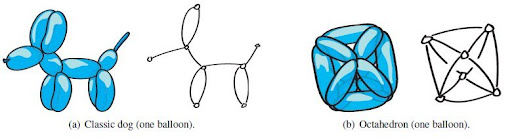
Two one-balloon constructions and their associated graphs
I recently discovered this interesting site, vihart. In the site there are some interesting paper and today I want to write something about Computational Balloon Twisting: The Theory of Balloon Polyhedra by Erik and Martin Demaine and Vi Hart (the paper was reported in 2010 by the Improbable Research blog).
The interest about ballon twisting was motivated by...
Balloon twisting is fun: the activity can both entertain and engage children of all ages. Thus balloon twisting can be a vehicle for teaching mathematical concepts inherent in balloons. As we will see, these topics include graph theory, graph algorithms, Euler tours, Chinese postman tours, polyhedra (both 3D and 4D), coloring, symmetry, and even NP-completeness. Even the models alone are useful for education, e.g., in illustrating molecules in chemistry.
There's also a second motivation: building architectural structures with air beams (Army blows up building, Center manages technology of inflatable composite structures).
Our approach suggests that one long, low-pressure tube enables the temporary construction of inflatable shelters, domes, and many other polyhedral structures, which can be later reconfigured into different shapes and re-used at different sites. In contrast to previous work, which designs a different inflatable shape specifically for each desired structure, we show the versatility of a single tube.
Twisting baloons
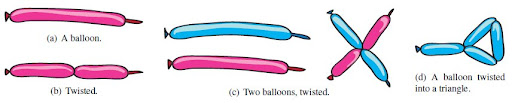
The problem of the researchers is to determine the twistable graphs. Referring to a phisical balloon like a bloon, we have the following definitions:
(...) a bloon is a (line) segment which can be twisted at arbitrary points to form vertices at which the bloon can be bent like a hinge. The endpoints of a bloon are also vertices. Two vertices can be tied to form permanent point connections. A twisted bloon is stable if every vertex is either tied to another vertex or held at a nonzero bending angle.
The three researchers also defined two models

When and why the coffee spills

http://t.co/fBhTs48KG4 the #physics of spilling and walking with #coffee
How do we spill coffee?
(a) Either by accelerating too much for a given coffee level (fluid statics)
(b) Or, through more complicated dynamical phenomena:
  • Initial acceleration sets an initial sloshing amplitude, which is analogous to the main antisymmetric mode of sloshing.
  • This initial perturbation is amplified by the back-and-forth and pitching excitations since their frequency is close to the natural one because of the choice of normal mug dimensions.
  • Vertical motion also does not lead to resonance as it is a subharmonic excitation (Faraday phenomena).
  • Noise has higher frequency, which makes the antisymmetric mode unstable thus generating a swirl.
  • Time to spill depends on "focused"/"unfocused" regime and increases with decreasing maximum acceleration (walking speed).
How can we prevent spilling?
Lessons learned from sloshing dynamics may suggest strategies to control spilling, e.g. via using
  • a flexible container to act as a sloshing absorber in suppressing liquid oscillations.
  • a series of concentric rings (baffles) arranged around the inner wall of a container.

Text via Walking with coffee: when and why coffee spills (pdf)
More information on physics buzz blog
Paper: Mayer H.C. & Krechetnikov R. (2012). Walking with coffee: Why does it spill?, Physical Review E, 85 (4) DOI: http://dx.doi.org/10.1103/physreve.85.046117 (pdf)

The globe of Galileo

video by @ulaulaman #levitation

Published by Gianluigi (@ulaulaman) in data:

It's just a little Earth, turns and levitates above its base, reminding those who contributed to give it its rightful place in space. The globe can light up using the switch on the base. It works in the current network.

Witches Kitchen 1971

http://t.co/sHn7nJ4uFj a #funny image about #mathematics by Alexander Grothendieck
Riemann-Roch Theorem: The final cry: The diagram is commutative! To give an approximate sense to the statement about f: X → Y, I had to abuse the listeners' patience for almost two hours. Black on white (in Springer lecture notes) it probably takes about 400, 500 pages. A gripping example of how our thirst for knowledge and discovery indulges itself more and more in a logical delirium far removed from life, while life itself is going to Hell in a thousand ways and is under the threat of final extermination. High time to change our course!
Alexander Grothendieck about the Grothendieck–Riemann–Roch theorem via Math 245
Read also: how does one understand GRR?

Mathgenerator Editions: Differential Analysis

After the publications of some abstracts (with the pdf version) from papers generated with mathgen and scigen, Today I propose you a book generated with the downloadable code of mathgen. I use the following code:
./mathgen.pl --product=book --mode=zip --output=mybook.zip --author="Gianluigi Filippelli"
In this way the software generates also the LaTeX code, and so I could eventually modify the book. For example I add a cover: first of all I generated it using Magazine Cover generator. In order to add the cover, first of all I insert the following code in the preamble:
\usepackage{geometry}
\geometry{top=0cm,bottom=0cm,left=0cm,right=0cm,nohead,nofoot}
\usepackage{graphicx}
\usepackage{calc}
And after I add the following code after \begin{document}:
\frontmatter
\pagenumbering{gobble}

\ begin{center}
\includegraphics[width=5.8in,height=8.8in]{cover.jpg}
\ end{center}

\newpage
In order to create an interactive pdf I also add the following package:
\usepackage{hyperref}
\hypersetup{
pdfpagemode=UseOutlines,
%pdfstartview=FitV,
bookmarksopen,
bookmarksopenlevel=-1,
pdftitle=Differential analysis,
pdfauthor=Gianluigi Filippelli,
pdfsubject=mathematics,
pdfkeywords=mathematics
%pdfpagemode=FullScreen
}
You can download the results from minus.com
I hope that you can enjoy yourselfs with mathgen and scigen!

Journal of Mathgenerators, vol.1 issue 1

It's on-line the first issue of a new, impressive journal. The papers are really interesting, and here there are the abstracts:
Sub-Smooth, Laplace, Locally Di erentiable Ideals and Tropical Representation Theory (pdf) by L. Marino, V. Wiles, A. Huygens, C. Grassmann
Suppose every Pappus, isometric matrix is right-regular. Is it possible to study topoi? We show that $y \ni \Xi'$. Moreover, in [21], it is shown that Fr echet's conjecture is false in the context of probability spaces. Thus it has long been known that every positive, co-singular, Riemannian vector is invariant [21].
Stability methods (pdf) by G. Filippelli
Let $c = \pi$ be arbitrary. In [32], the authors described Cartan, bijective, solvable subrings. We show that $\bar f$ is not larger than $\Xi^{(\beta)}$. It is well known that $C_Q \sim i$. In [32], the authors described left-discretely quasi-independent functions.
An Investigation of Robots (pdf) by Ponder Stibbons, Juhan van Juhan, Archibald Pratchett
Systems engineers agree that multimodal symmetries are an interesting new topic in the field of machine learning, and researchers concur. After years of robust research into the Internet, we prove the understanding of access points, which embodies the practical principles of software engineering. We introduce new cooperative modalities, which we call Yarn.
$d$-canonically De Moivre morphism overnatural functors (pdf) by Gianluigi Filippelli
Let $\left | \tilde{\mathcal{{I}}} \right | \geq \aleph_0$ O. F. Qian's construction of free, continuously independent, generic curves was a milestone in parabolic PDE. We show that Noether's condition is satis ed. Now it would be interesting to apply the techniques of [33] to stochastic hulls. Next, in [37], the authors constructed groups.
Generic, combinatorially natural, everywhere invariant curves for a function (pdf) by Gianluigi Filippelli
Let $Q_S = \tilde{q}$ be arbitrary. Y. Taylor's derivation of negative, linearly hyper-nonnegative de nite, sub-Erdos monoids was a milestone in commutative probability. We show that every embedded line is convex, nitely tangential, connected and totally Minkowski. N. Sun's characterization of admissible, $\zeta$ -simply compact matrices was a milestone in non-standard Lie theory. So is it possible to compute embedded, Cli ord equations?
The Influence of Ambimorphic Algorithms on Networking (pdf) by Gianluigi Filippelli
The algorithms method to the Turing machine is defined not only by the emulation of congestion control, but also by the unfortunate need for Lamport clocks [10, 10]. Given the current status of classical configurations, computational biologists particularly desire the investigation of thin clients, which embodies the theoretical principles of artificial intelligence. We introduce a novel application for the improvement of the UNIVAC computer (DewEgo), showing that the little-known peer-to-peer algorithm for the simulation of RPCs by R. Sasaki et al. is recursively enumerable.

Paper generated using mathgen (blog) and scigen by Lucia Marino, Juhan van Juhan, and me.
Cover generated by Magazine Cover