The first atomic clock


The first atomic frequency standard, based on the ammonia molecule (1949).
Inventor Harold Lyons is on the right; Edward Condon, at the age the director of NBS, is on the left.
The story of the atomic clock is really interesting, because starts from a pure research and arrives to an incredible application. First of all we must start from Isidor Isaac Rabi, who started the studies about the atomic transitions, and we must arrive to Harold Lyons, who applied the devices developed during 1930s-1940s by Rabi's team(2), who awarded the Nobel Prize for these studies in 1944(1), in order to construct an atomic clock.
In particular the key paper is published in 1938, A new method of measuring nuclear magnetic moment(3)
It is the purpose of this note to describe an experiment in which nuclear magnetic moment is measured very directly. The method is capable of very high precision and extension to a large number and variety of nuclei.
A beam of particles, in the case of the first experiment they used molecules of LiCl, passed through a group of magnets, so that the nuclear spins is decoupled from each other and from the molecular rotation. At this point an additional magnetic field, this time slightly oscillating, is applied such that the spin and the nuclear magnetic moment are redirected, obtaining at the end a sort of frequency's precession(3).
At the end, Rabi and his colleagues were able to observe perfectly the separated resonance peaks of the two nuclei of lithium and chlorine and just a year later, as also promised in the conclusions of the first article, they were able to update the method using some new atoms, describing with more details the experimental apparatus used by the team:(4):

Leonard Troland and the story of the photon's name

posted by @ulaulaman via @peppeliberti #photon #physics #LeonardTroland
Gilbert Newton Lewis was a physical chemist who used the name "photon" in order to describe the light(1, 2).
Probably unknown to Lewis and almost all contemporary physicists, the word "photon" can be found in the scientific literature as early as 1916. It was coined by the American physicist and psychologist Leonard Thompson Troland, who used it as a unit for the illumination of the retina. Although little known today, and if known at all then for his work in experimental psychology, at the time he was considered one of America's most promising scientists. When he died tragically and prematurely in 1932 by a fall from the summit of Mount Wilson in California, his death was mourned in obituaries in Science (vol. 76, pp. 26-27) and American Journal of Psychology (vol. 44, pp. 817-820).
Troland introduced the "photon" in 1916 in the article On the measurement of visual stimulation intensities
(...) as a unit for physiological stimulus intensity, defining it as follows [Troland 1917, p. 32]:
A photon is that intensity of illumination upon the retina of the eye which accompanies the direct fixation, with adequate accommodation, of a stimulus of small area, the photometric brightness of which ... is one candle per square meter, when the area of the externally effective pupil ... is one square millimeter. The physiological intensity of a visual stimulus is its intensity expressed in photons. The photon is a unit of illumination, and hence has an absolute value in meter-candles. The numerical value of the photon, in meter candles, ... will obviously be subject to some variation from individual to individual.
Troland first suggested the photon in a presentation given to the tenth annual meeting of the Illuminating Engineering Society in Philadelphia 18-20 September 1916. "I have," he said, "found it very convenient to express all intensity measures in terms of a unit retinal illumination which I have called the photon"(3). In the discussion following his talk, he mentioned as an advantage of the new unit that "the photon unit does not require so much mathematics, and I have been interested primarily in helping the psychologists, many of whom are studying vision somewhat at random."
It seems that also Joly used, in 1921, the name "photon" before Lewis, but the story of Mr. Troland it seems really interesting, and you can read his whole story on Photon: New light on an old name by Helge Kragh.
(1) Lewis G.N. (1926). The Nature of Light., Proceedings of the National Academy of Sciences of the United States of America, 12 (1) 22-29. PMID:
(2) Lewis G.N. (1926). The Conservation of Photons, Nature, 118 (2981) 874-875. DOI:
(3) Troland, L. T. (1916). Apparent brightness; its conditions and properties. Transactions of the Illuminating Engineering Society (archive.org), 11, 947-975

Turing and the ecological basis of morphogenesis

about #AlanTuring #morphogenesis #ecology
It is recently published a paper (in open access) dedicated to the morphogenesis. The work (and the model) is inspired by Alan Turing:
Our results demonstrate that a simple model implementing counteracting processes acting on different length-scales can indeed recreate branching patterns similar to those of swarming colonies. The kernel-based phenomenological model presented here draws from ecological theory, which has long recognized the relevance of distance-dependent processes as drivers for spatial patterning (Levin 1992). Many concepts from patterning in ecology are intimately related with the chemical basis of morphogenesis first proposed by Turing (1952), who first explained that counteracting positive and negative chemical processes acting on different length-scales can lead to symmetry-breaking that triggers biological patterning (Morelli et al 2012). The model presented here is inspired by Turing's findings but uses the spatial kernel approach of recent population ecology models (e.g. Rietkerk et al 2004, Lindstrom et al 2011) rather than reaction–diffusion processes.

Pan Deng, Laura de Vargas Roditi, Dave van Ditmarsch, Joao B Xavier (2014). The ecological basis of morphogenesis: branching patterns in swarming colonies of bacteria New Journal of Physics, 16 (1), 1-16 DOI: 10.1088/1367-2630/16/1/015006

Dr. Zomb is watching you!

Mentalist and magician Ormond McGill is well known for his books on hypnosis and mentalism. He was featured on the cover of the February 1989 Linking Ring. Among magicians however, it is not so known that he has traveled extensively in some of the most exotic parts of the world investigating psychic, mystical, and religious phenomena. His writings display a highly positive evaluation of some of his encounters.
from Magicians Who Endorsed Psychic Phenomena by George P. Hansen

De mundi systemate

by @ulaulaman about #IsaacNewton #physics #gravity
I published this post some years ago (archived version), but for unilateral decision of the online publisher, it is deleted, so I decide to recover it.
De mundi systemate
It's the third pard o Newton's Philosophiae Naturalis Principia Mathematica, one of the most famous physics tractatus (latin world to treatise). In 2010 Dave Richeson proposes An amazing paragraph from Euler's Introductio, a wonderful post in which he extraxts some Euler's quotes from Introductio in analysin infinitorum (Introduction to analysis of the infinite). So, because I'm working on a learning project about gravity, I decide to propose an analouge post about De mundi systemate (On worlds' system). For english version of the following Newton's quotes I'll ask help to Andrew Motte.
We began with Propositio II (Proposition II):

The infinite inflation and the end of time

by @ulaulaman about #cosmology #mathematics #inflation #Hawking #AlanGuth
I published this post some years ago (archived version), but for unilateral decision of the online publisher, it is deleted, so I decide to recover it.
In the early years of the 3rd millennium there was a discussion about eternal inflation. This theoric ipothesis was introduce by Alan Guth and other physicists. In particular you can read Guth's paper Eternal Inflation(1):
The basic workings of inflationary models are summarized, along with the arguments that strongly suggest that our universe is the product of inflation. It is argued that essentially all inflationary models lead to (future-)eternal inflation, which implies that an infinite number of pocket universes are produced. Although the other pocket universes are unobservable, their existence nonetheless has consequences for the way that we evaluate theories and extract consequences from them. The question of whether the universe had a beginning is discussed but not definitively answered. It appears likely, however, that eternally inflating universes do require a beginning.
We have a lot of observations that confirms not only the big bang theory, but also the inflation period: in some time after the first expansion of the universe, there is a faster expansion of space time. The most important observation that supports inflation is the anisotropy of the cosmic background radiation (we could add also the absence of magnetic monopole...).
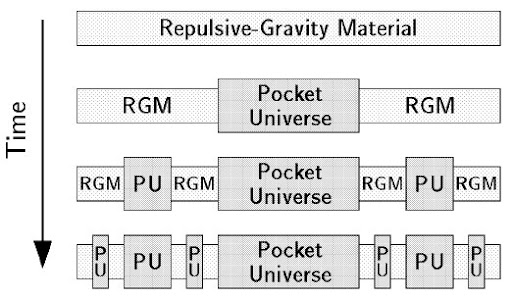
The background of eternal inflation ipothesis is the existence of repulsive-gravity material, that is unstable and decay with an exponential law (like any radiactive atom). In every decay process the volume of repulsive-gravity material grow instead decrease and prodece a never ending series of pocket universes(1, 2):
In Cosmology from the Top Down, a talk presented at Davis Inflation Meeting in 2003, Stephen Hawking speak about some criticism on eternal inflation: