

The B mesons and the new physics
The search about B mesons decays has a great importance in physics for the possible clues of new physics that could be discovered. So theoretical phisicists have developed some new observables in order to test this possibility. LHCb produced new results about these new parameters, in particular the so called $P_5'$.

The image shows the distribution of the $P_5'$ observable as a function of the $\mu^+ \mu^-$ invariant mass squared $q^2$. The black data points are compared with the Standard Model prediction.
According to Joaquim Matias from Universitat Autonoma de Barcelona and colleagues the deviation in $P_5'$ and small discrepancies in the other angular observables for this decay, follow a pattern. In a recent paper the authors claim that a global analysis of the LHCb data, together with previous measurements, show a deviation of $4.5 \sigma$ with respect to Standard Model expectations, which can be explained with the same mechanism. This demands further investigation, in particular to re-evaluate all the sources of theoretical uncertainty, and to understand the effects of correlations between the experimental measurements.(via LHCb)
The image shows the distribution of the $P_5'$ observable as a function of the $\mu^+ \mu^-$ invariant mass squared $q^2$. The black data points are compared with the Standard Model prediction.
Paul Dirac and the relativistic world
It seems to be one of the fundamental features of nature that fundamental physical laws are described in terms of a mathematical theory of great beauty and power, needing quite a high standard of mathematics for one to understand it.
(Paul Dirac)

From this we need to describe the world from the point of view of quantum relativistic: the Klein-Gordon equation is born: \[\partial^\mu \partial_\mu \phi + m^2 \phi = 0\] It has two drawbacks: negative energy as a solution and interpretation of the wave function. If, as in quantum mechanics, we associate the wave function with probability, or rather the probability's density, it happens that this can also take on negative values. At this point arrived the Dirac equation: \[\left ( i \gamma^\mu \partial_\mu - m \right ) \psi = 0\] Thanks to the Dirac equation, whose one of the first success was the explanation of half-integer spin of the electron, we now have two fundamental tools: the first for the description of bosons (particles with integer spin), the second for the description of fermions (half-integer spin particles).
Read also: The Relation between Mathematics and Physics, a lecture by Dirac
In the image: Paul Dirac by George Gamow
Turing, Fibonacci and the sunflowers

One of a number of problems [Alan Turing] was trying to solve was the appearence of Fibonacci numbers in the structure of plants.(1)The problem was knwon as the Fibonacci phyllotaxis, and we can state it in this way:
the spiral shapes on the heads of sunflowers seemed to follow the Fibonacci sequence, prompting [Turing's] proposal that by studying sunflowers we might better understand how plants growTuring wrote his interest in a letter to the zoologist JZ Young:
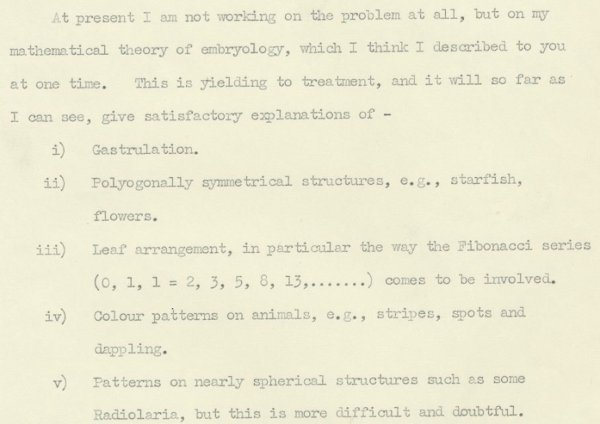
Our new machine is to start arriving on Monday. I am hoping to do something about 'chemical embyology'. In particular I think I can account for the appearence of Fibonacci numbers in connection with fir-cones.(1)The last year Jonathan Swinton, during the Manchester Science Festival in October, announced the results of the great experiment about the Turing's sunflower:
The equation of everything
Following Cedric Villani, let you imagine a pond. Everything is calm and quiet, without a breath of wind, but at acertain point the pond surface is perturbed by a wave, without any external force. The next minute everything returns calm and quiet.
Villani used this poetical picture in order to describe some results about the Euler equation for an incompressible fluid: \[\frac{\partial v}{\partial t} + \nabla \cdot \left ( v \times v \right ) + \nabla p = f\] \[\nabla \cdot v = 0\] About this equation (or this sistem of wave equations), Scheffer (in 1993) found that the equation permit the spontaneous creation of energy form nothing, while Shnirelman (in 1997), found a new proof of this fact and proposed to enforce a criterion for physically prevent this kind of mathematical solutions. Sheffer and Shnirelman Theorem:
Villani used this poetical picture in order to describe some results about the Euler equation for an incompressible fluid: \[\frac{\partial v}{\partial t} + \nabla \cdot \left ( v \times v \right ) + \nabla p = f\] \[\nabla \cdot v = 0\] About this equation (or this sistem of wave equations), Scheffer (in 1993) found that the equation permit the spontaneous creation of energy form nothing, while Shnirelman (in 1997), found a new proof of this fact and proposed to enforce a criterion for physically prevent this kind of mathematical solutions. Sheffer and Shnirelman Theorem:
There is a weak solution of the Euler incompressible equation in 2-dimensions, without forcing ($f \equiv 0$) with compact support in space-time.Between 2007 and 2008 De Lellis and Szekelyhidi proofed a more general theorem that establishes, among other things, that the criterion of Shnirelman is not valid, or, in other world, that the solutions of the Euler incompressible equation without forcing are physically acceptable.
First evidence of photon polarisation in a quark transition

is considered a very important process to investigate possible manifestation of new physics. This decay process is forbidden in the first approximation in the Standard Model (SM) of particle physics and moreover in the second-order processes that govern the process in the SM the emitted photon is expected to be strongly polarised. Therefore it is very sensitive to new physics effects arising from the exchange of new heavy particles in electroweak penguin diagrams (see 14 June 2013 news). Indeed, several models of new physics predict that the emitted photon should be less polarised than in the SM. Up to now different experiments have measured the decay rate of this process, ruling out significant deviations of the rate from the SM prediction and strongly reducing the allowed parameter space of new physics models. The photon polarisation was, however, never previously observed.I think that this is a really intriguing news for a particle physics point of view.
Subscribe to:
Posts (Atom)