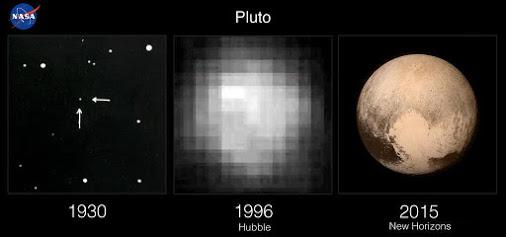
about #Lovecraft, #Pluto, #Lowell and #Tombaugh
The story of the
Pluto's discovery started with
Urban Le Verrier, a French mathematician that he was interested in celestial mechanics: performing some newtonian calculation, on on 31 August 1846, he announced the prediction of a planet beyond Uranus. This planet, Neptune, was discovered one month later by the astronomer
Johann Gottfried Galle about 1° of the position predicted by Le Verrier. From further observation, astronomers supposed that there was another planet that perturbed Uranus' orbit.
Meanwhile in Providence
a young boy growing with the passion of astronomy:
Howard Phillips Lovecraft, in a letter to
Rheinhart Kleiner on 16 November 1916, wrote:
In the summer of 1903 my mother presented me with a 2-1/2" astronomical telescope, and thenceforward my gaze was ever upward at night. The late Prof. Upton of Brown, a friend of the family, gave me the freedom of the college observatory, (Ladd Observatory) & I came & went there at will on my bicycle. Ladd Observatory tops a considerable eminence about a mile from the house. I used to walk up Doyle Avenue hill with my wheel, but when returning would have a glorious coast down it. So constant were my observations, that my neck became much affected by the strain of peering at a difficult angle. It gave me much pain, & resulted in a permanent curvature perceptible today to a close observer.(1)
Thanks to this passion for cosmos, Lovecraft starting to write
The Rhode Island Journal of Astronomy:
In January, 1903, astronomy began to engross me completely. I procured a small telescope, and surveyed the heavens constantly. Not one clear night passed without long observation on my part, and the practical, first-hand knowledge thus acquired has ever since been of the highest utility to me in my astronomical writing. In August 1903 (though I knew nothing of the press associations) I commenced to publish an amateur paper called The R.I. Journal of Astronomy, writing it by hand, and duplicating it on a hectograph. This I continued for four years, first as a weekly, later as a monthly.(1)
he wrote in a letter to
Maurice W. Moe, on 1 January 1915.
In this way he could perform a lot of observations and he also supposed the possible existence of a new planet beyond Neptune, like he wrote on a letter to the
Scientific American:


