Showing posts with label review. Show all posts

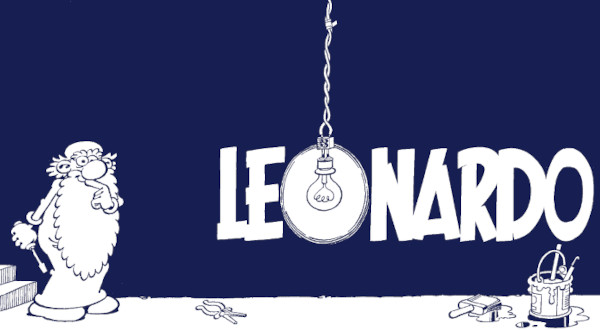
Leonardo, a comics genius

20211106-leonardo-europe-comics
Léonard by Turk & De Groot is a particularly long-lived humorous series: after having made its debut in 1975 on the pages of Achille Talon magazine, it was subsequently serialized starting from March 1977 in a series of volumes, now in its 51st edition. June 2020. Now the first two volumes are also available in english thanks to the digital edition of Europe Comics (volume 1 and volume 2).
Originally Bob De Groot, the screenwriter, had imagined an inventor named Methuselah as the long-lived biblical character, but later opted to focus on Leonardo da Vinci. On the other hand, this initial idea leaves traces in the drawings of Philippe Liégeois, known as Turk: Leonardo, in fact, is outlined with a white bum constantly in motion.
The two authors focus above all on Leonardo the inventor, a choice that allows them to show the scientist's variety of interests and his brilliant and multifaceted mind. With an irreverent spirit, the two belgian cartoonists create a series of gags, some of a purely visual page, others developed over a dozen pages, in which one laughs not only with, but also about Leonardo.
A heartfelt tribute to one of the greatest geniuses in the history of Italy and the world.

Travelling on Sputnik 2

The Mysterious Traveler was a multimedia project as it could only be before the advent of the world wide web: it was a radio program, which started on the 5th december, 1943 and went on, with mixed fortunes, until the 16th september, 1952; an anthological magazine (on which Ray Bradbury among others wrote short stories), published between 1951 and 1952; and a comic book, also anthological, of which 13 issues were released every two months between august 1956 and june 1959 (not counting the two volumes of 1985). Published by Charlton, it had Steve Ditko as its leading artist (he was not the only one, anyway) and, like the other two products that preceded it, contained fantasy and science fiction stories with a hint of crime.
The protagonist of Tales of the Mysterious Traveler (this is the name of the comic book) is a... mysterious traveler in a raincoat and with a wide-brimmed hat pulled over his eyes. The mysterious traveler moved from the most disparate corners of the universe and there was no barrier capable stopping him, neither the boiling heart of a planet, nor the cold and dark desolation of outer space.
On #12, the mysterious traveler is sent (perhaps) by Joe Gill and Bill Molno aboard Sputnik 2. This was the second object launched by the Soviets into space, and the first to bring a living being on board, the dog Laika.

Beneficio

Evaluating Beneficio is by no means trivial. The narrative is all concentrated around a woman in search of herself, remembering her missing grandmother.
There is not only this, however. The protagonist's journey takes her to Beneficio, a valley near the Spanish village of Orgiva where there is a community that lives in contact with nature in self-built tents, tepees and shelters.
In this environment the woman begins to reflect on her life and then passes, without any solution of continuity, to the universe and the divine, mixing fantastic, almost religious ideas, with the great scientific questions still unanswered. All within a valley surrounded by large mountains, wild and peaceful.
The narrative itself fits the theme: the story is diluted and rarefied, the pages with the minimum number of vignettes (rarely more than three or four), while the drawings now look like travel sketches, at other times particularly detailed.
Overall, both from a narrative and an aesthetic point of view, Beneficio by Michał Kalicki and Krzysztof Gawronkiewicz is almost a land version of Daisuke Igarashi's Children of the sea.

Robot stories

The comic transposition of Isaac Asimov's I, robot created by Raul Cuadrado is reminiscent of the first flash animations of a decade ago, a bit like the style of Carlos Meglia, famous in particular for Cybersix. Made on a horizontal rather than vertical page structure reminiscent of newspaper strip stories, the comic book I, robot is a quick and intelligent reading, with a slightly retro style thanks to the duotone, true to Asimov's spirit.

Human: the man of the future

500,000 years and more in the future. Disused satellites and space debris orbit around the Earth. Among these there is a structure that resembles a space station. Suddenly a module detaches and crashes onto the planet. After the explosion, we follow an animal that, from the top of a cliff, spreads its wings and flies to the impact site. From the relatively distant readers' point of view, the flying shadow could be a pterodactyl and the Earth we see, in reality, that of prehistory: even the vegetation and the gigantism of the environment would seem to suggest it. Instead, when we get closer to the impact site, the figure becomes more defined: it is a kind of monkey with wings.
The guides in the exploration of this regressed world of the future are Diego Agrimbau and Lucas Varela and they use a robot, Alpha, as their guide. His job is to assist the terrestrial scientist Robert who, together with his wife June, devised a complex plan to repopulate the Earth with homo sapiens. Robert, in fact, predicting the fate of extinction of human beings, has decided to freeze himself and his wife while waiting for the planet to recover from the ecological disasters left on its surface by the passage of the human race.

A journey to Proxima Centauri


Proxima Centauri is a red dwarf located approximately 4.2 light years from us, in the area of ​​sky covered by the Centaur constellation. Thanks to ESO's telescopes, in particular to the HARPS spectrograph, and using the Doppler (or radial velocity) method, in 2016 it was anounced the discovery of a planet around this star, Proxima Centauri b.
Given the proximity, one might think that the world of comics has devoted much attention in recent years to the star and its planet. In fact, to have a comic set around this star, you have to wait until the second half of 2018 when Image Comics publishes the six-issue miniseries Proxima Centauri by Farel Dalrymple.
The work, subsequently collected in volume in January 2019, is halfway between science fiction and fantasy. The main character is Sherwood Breadcoat, a teenage magician trapped on an artificial spheroid called Proxima Centauri, evidently put in orbit around the homonymous star. Of course, this information is not very clear, but overall the whole Dalrymple comic is rather lack of information, closed in a hermetic narration with an open ending that allows the author keep some subplots open, like the relationship between Sherwood and the scientist, that sometimes seems help the teen, other times usi it for his purposes; or as one of Sherwood's opponents, which is actually a sort of virtual, but also physical manifestation of a character hidden somewhere on the spheroid and who seems to be a videogame player, given that he explicitly states that he wants to repeat the vlash with Sherwood, although it ended badly more than once.
In all this, although science would seem to play a fundamental role, at least according to some lines of Breadcoat, a character who believes only in science and magic (?), it is a simple narrative accessory, a way to not deepen the technology used or to hide all the magical aspects of the story, only apparently sci-fi.
In any case, Dalrymple's comic is good to remember that, quite recently, a team of Italian astronomers, studying the data coming from Proxima Centauri with more accuracy, has supposed the existence of a second planet around the star, roughly six times more massive than Earth. We will see if it will be confirmed or not.

Feynman in comics

with @estuan about #Feynman #Ottaviani #Myrick #comics #physics
Italian version written with Maria-Angela Silleni.
Feynman by Ottaviani and Myrick, reported by Maria Popova as one of the top 11 scientific popular books of 2012, is a splendid example of how to make interesting science. Even with the comics.
Telling a man’s life is always an arduous and difficult task. So it is necessary to make choices, often focusing on successes and leaving aside failures, especially if you talk about a physicist who has been interested in the most disparate fields within his specialization.
This is the some idea that Lawrence Krauss has dealt with the life of Richard Feynman in Quantum Man and the same spirit seems to animate Feynman, the graphic novel by Jim Ottaviani and Leland Myrick.
Introducing Feynman?
After the series of Introducing, a hybrid of illustrated and comic books about science, one of the most effective comics dedicated to science, brings the signature of Ottaviani, which, on the pages of Suspended In Language, with the contribution of the comic artist Leland Purvis, told the life of Niels Bohr, the master of the Copenhagen School, whose interpretation of quantum mechanics dominated during the first steps of this new approach of physics to nature.
Ottaviani knows very well the risks in comic book science genre: in particular, falling into teaching and slamming the reader into boredom is always around the corner; so thanks to an episode narrative (which is also a limit, as we shall see below), accompanied by synthetic drawings, the volume reaches the disclosure purpose without betraying the aspect of entertainment.
A great role in the success of the graphic novel is dued by the subject: Feynman, Nobel Prize in Physics in 1965, was an eccentric character with a strong sense of humor and impatient with social conventions. Thanks to these features he often found himself in embarrassing situations with unexpected consequences. A passionate bongo player and amateur sketcher of naked women, picked up his two-volume adventures, Surely You’re Joking, Mr. Feynman! and What Do You Care What Other People Think?, which wrote to seem not overly serious: and most of the episodes narrated in the comic are getting from his autobiographical stories.

Alice underground: the door, the quaternion and the relativity

Alice underground is the first version of Aline in the wonderland by Lewis Carroll. The original manuscript, illustrated by Carroll himself, was given to the little Alice Liddell for Christmas in 1864 and picked up the story that he had told to Alice and her sisters Lorina and Edith during a summer's afternoon, precisely on July the 4th, 1862. This first version of the carrollian fantasy novel is, ultimately, a restricted version of Alice, where various characters and episodes completely absent in Underground are added, such as the Duchess or the team composed by the Mad Hatter, the March Hare and the Dormouse.
The intial, interesting considerations about underground is about the importance of the trees and the doors: following the suggestion by Adele Cammarata(3), we can assume that the tree and the door that Alice cross to enter the garden of the Queen of Hearts, completely absent in Wonderland, is linked with the Celtic tradition. Indeed the oak is one of the sacred trees of the druids, symbolizing a link between heaven and earth(1). In this way the oak, which in Celtic was called duir, is a real door that connects people with the gods, but also ourselves with our inner part. So, from an etymological point of view, a carved door in a tree trunk is a Celtic symbol used to identify the Alice's passage towards a more stable phase after the size's changes of the previous scenes.
These changes in size, alluding both to the transition to adulthood, in perfect connection with the Druidic symbolism, and with the more classic homothetic transformations, i.e. the transformations which, without changing the proportions of a geometric figure, change its size. All these changes remain unchanged in the transition to the second version, including the meeting with the Caterpillar, who continues to ask Alice:
Who are you?

Doubt like a salmon

An happy #towelday to all readers!
If you has ready and appreciate also one book by Douglas Adams, I think that you could have a little idea of what the people who knew him proved after his death. So, Peter Guzzardi composed The Salmond of Doubt with the idea to make an hearthful tribute to the writer of the Hitchhiker's Guide using unpublished articles, interviews and the third unfinished novel of the series of Dirk Gently, which also gives its name to collection.

from the italian cover of the book, by Franco Brambilla

Annihilator: Hollywood, the galaxy and everything

by @ulaulaman a review of #Annihilator, a #cosmic #comics by Grant Morrison and Frazer Irving
Rabbits are animals extremely prolific, almost legendary in their rate of reproduction, so that Leonardo Fibonacci, thanks to these cute rodents, discovered (or re-discovered) the series that bears his name: 1 1 2 3 5 8 13 21 and so on, and where each number is the sum of the previous two.
However, it is astonishing to note how pervasive within nature this series of numbers is: we can find it, for example, in the arrangement of seeds of sunflowers(1), in the structure of shells of turtles, in the spirals of seashells. Or, again, in the spiral galaxies(2).

M51 (Whirlpool Galaxy) - source: reddit, NASA
Journey through the universe
The galactic matter, in fact, revolves around the center of every galaxy often making spiraling structures, arms of solid and gaseous matter that we can describe with the Fibonacci series as they fall toward the center, slowly swallowed up by an object apparently absurd but absolutely real: the supermassive black hole. So, within each spiral galaxy there is a black hole(3, 4), which at the same time is the reason for the existence(5) and the ultimate fate of galaxies like our Milky Way, the center of which lies Sagittarius A*(6).
Almost nothing escapes from the event horizon of this cosmic monster: let you imagine the matter while, piece by piece, falls within it, decomposed into its fundamental constituents, and the only trace of this meal is a simple, small radiation X(7), a slight heat that escapes, evidence of a millennial digestion. It is in this border area that is brought Max Nomax, adventurer and genius, looking for "a cure for death", a way to be reunited with his beloved in life, the protagonist of a classic cosmic science fiction story written by the equally genial Ray Spass, Hollywood screenwriter in creative crisis and tormented by his manager, who presses him to get the script for a new film series, Annihilator.
With this latest work Grant Morrison, mixing the classic kirbyan superhero inspiration with real insights arrived from his Hollywood's patronage, builds a story that is a bit of an existential drama, a bit of a parody of the world of cinema, a bit of a great science fiction story. The comparison between creature and creator, here achieved simply with the description of their respective alternate adventures, brings near the two main characters, both anti-heroes, and from another point of view move them away for motivation and potential, creative or destructive according to their motivation.

Laika: a comics about a hero

Laika was the first living being to go in space. Its adventure was written by Rick Abadzis in a beautiful graphic novel, that I read two years ago.
The story began with Sputnik 1, the first russian space mission launched in space on October 4, 1957, in order to send a signal to Earth. The next mission, Sputnik 2, launched on November 3, 1957 with the first living thing on board, a dog, Laika. This second mission, however, arose under pressure from the government, which would celebrate the fortieth anniversary of the October revolution with a new, great success of the spatial plan of the Soviet Union. So the mission was prepared in haste, designing a less sophisticated satellite than Sputnik 1 that was not expected it would be back on the planet: a death sentence beyond a reasonable doubt for his passenger. Laika's death, however, was very early: the mission was designed to last a week or less, but the dog died long before, in 5-7 hours:
The fact, that pressure in the cabin was not reduced, proved its reliable tightness. It was very important, as the satellite passed through areas of meteoric flows. Normalization of parameters of breath and blood circulation of Layka during orbital flight has allowed to make a conclusion, that the long weightlessness does not cause essential changes in a status of animal organisms. During flight the gradual increase of temperature and humidity in the cabin was registered via telemetric channels. Approximately in 5 - 7 hours of flight there was a failure of telemetry system. It was not possible to detect a status of the dog since the fourth circuit. During the ground simulation of this flight's conditions, the conclusion was made, that Layka should be lost because of overheating on 3d or 4-th circuit of flight.(1)
So, the hypothesis of silence imposed from above on the health conditions of Laika, or more than anything else on the impossibility to monitor them, told by Abadzis are not so far-fetched: we must consider, in fact, that the animal (in the government vision) would had to stay alive in time to celebrate the forty years of the October Revolution!
And the British cartoonist tells not only the historical background of Laika's story, but also the simple story of a dog that goes in space from the street and the story of the people who shared their life and love with the little dog.
A graphic novel, made with the classic bd style, that you can not miss in your collection.
(1) Dmitrij Malashenkov, Some Unknown Pages of the Living Organisms' First Orbital Flight

Review: Death from the skies

#SciDoom
The universe is trying to kill you.
Philip Plait, Death from the skies
The Universe is the most dangerous place that you can imagine. There are a lot of perils: asteroids and comets, supernavae, gamma ray bursts and finally our star, the Sun. Every source of danger is examined in nine chapters introduced by a fictional short story, that is scientifically correct. In these introductory stories, Plait describes a possible scenario in which Earth is shotted by, for example, a comet o a great asteroid, like the one that leaves the Meteor Crater in Arizona
or the ones that probably caused the dinosaurs extintion.
More about Death from the Skies!In order to prevent a bad encounter with a great object, physicists describe a lot of possible solutions: in the list there are a nuclear bomb, an impact against an artificial object (like Deep Impact with Tempel 1) or try to change the bullet's trajectory using the gravitational force of an ather astetoids. This last solution is proposed by B612 Foundation and, like the others, present a lot of difficulties, but is technically realizable now!
Some possible problems are, for example with shot solutions, that the object is broken into too big pieces, while for the gravitational solution we must demonstrate a very precise control of the gravity. These are the only enemies we can prevent, but against the others we could realize some particular protection, like radiations from Sun or from supernovae explosions. In this last case, the probability to be shot is 1/10000000, against 1/700000 of an asteroid shot, that is a probability actually higher than terrorism!
Another danger from outer space is an... alien attack! Don't worry! I don't mean the little green men from Mars, but simply eventually microscopic life present in asteroids or comets. An attach like this has a very low probability, first of all because the aliens must survive at Earth atmosphere, and after because they have a low probability to interact with DNA developed in our environment: following our knowledge, we must remeber that in the Universe our planet is unique!
I don't know if we are alone or not, but in this moment it is so...
In the last part of the post I spend some words about Sun: