No, this is not the towel day, but what ESO released yesterday is undoubtedly something quite useful for any space tourist: a series of 42 detailed images of the largest asteroids in the solar system.
The main asteroid belt, located just beyond the orbit of Mars, is made up of rocky objects of various sizes, reaching up to 200 km in diameter, without forgetting the largest of all, Ceres and Vesta, respectively 940 and 520 kilometers in diameter.
The family portrait of the 42 asteroids was made using the Very Large Telescope:

Showing posts with label asteroids. Show all posts
Showing posts with label asteroids. Show all posts

The dog-bone asteroid
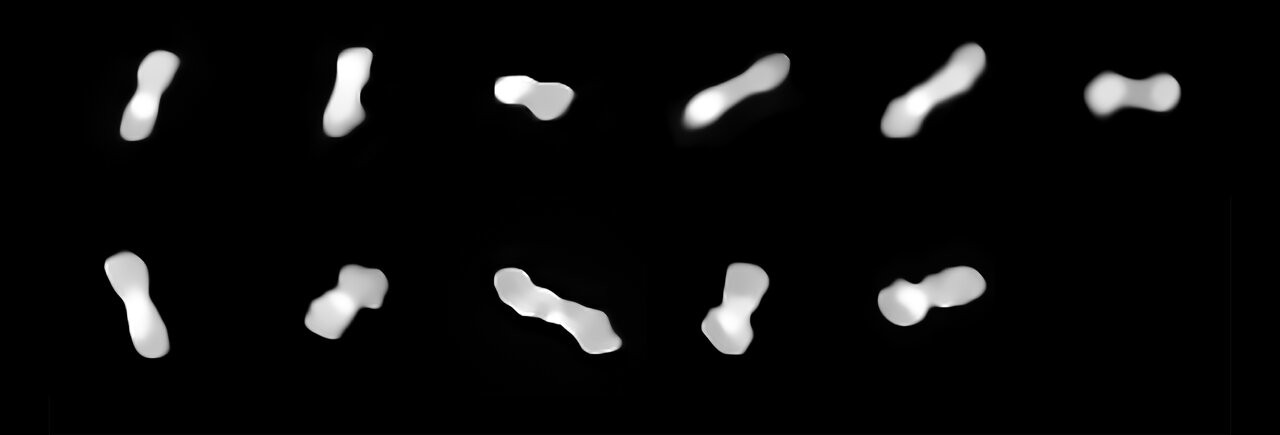
Using the European Southern Observatory's Very Large Telescope (ESO's VLT), a team of astronomers have obtained the sharpest and most detailed images yet of the asteroid Kleopatra. The observations have allowed the team to constrain the 3D shape and mass of this peculiar asteroid, which resembles a dog bone, to a higher accuracy than ever before. Their research provides clues as to how this asteroid and the two moons that orbit it formed.Kleopatra also possesses another characteristic: a two-moon system discovered in 2008 by Franck Marchis' team at the Keck Observatory.
It is interesting to observe that the dynamics of Kleopatra's three-body system and its moons turn out to be chaotic. I hope to soon publish an article on the problem of the three bodies to clarify this aspect.
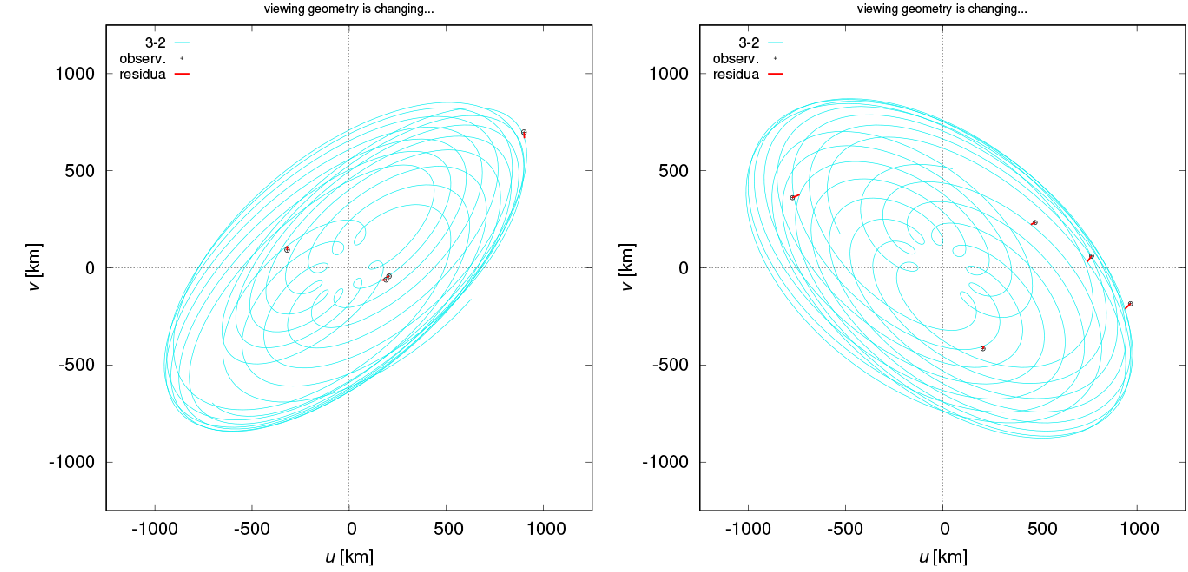
Read ESO's press release
Marchis, F., Jorda, L., Vernazza, P., Brož, M., Hanuš, J., Ferrais, M., ... & Yang, B. (2021). (216) Kleopatra, a low density critically rotating M-type asteroid. Astronomy&Astrophysics, 653. doi:10.1051/0004-6361/202140874
Broz, M., Marchis, F., Jorda, L., Hanuš, J., Vernazza, P., Ferrais, M., ... & Yang, B. (2021). An advanced multipole model for (216) Kleopatra triple system. Astronomy&Astrophysics, 653. doi:10.1051/0004-6361/202140901
Broz, M., Marchis, F., Jorda, L., Hanuš, J., Vernazza, P., Ferrais, M., ... & Yang, B. (2021). An advanced multipole model for (216) Kleopatra triple system. Astronomy&Astrophysics, 653. doi:10.1051/0004-6361/202140901
Descamps, P., Marchis, F., Berthier, J., Emery, J. P., Duchêne, G., De Pater, I., ... & Macomber, B. (2011). Triplicity and physical characteristics of Asteroid (216) Kleopatra. Icarus, 211(2), 1022-1033. doi:10.1016/j.icarus.2010.11.016
Subscribe to:
Posts (Atom)