
Explore how white dwarfs contribute essential carbon to the cosmos, impacting debates about its origins in the Milky Way.
Read more

Explore how white dwarfs contribute essential carbon to the cosmos, impacting debates about its origins in the Milky Way.

2024 Nobel Prizes spotlight breakthroughs in AI, neural networks, and protein folding advancements.I apologize for the delayed publication of this post, but due to the problems with the security certificate that I was writing last week, I preferred to leave this article on hold, so I'm recovering it now.

Masaki Kashiwara wins the 2025 Abel Prize for groundbreaking work in algebraic analysis, D-modules theory, and crystal bases in representation theory.Continue reading

The Authors propose a didactic model representative of the particles described of the Standard Model. In this approach, particles result to be geometric forms corresponding to geometric structures of coupled quantum oscillators. An in-depth phenomenology of particles surfaces and this seems fully compatible with that of the Standard Model. Consequently, it is possible to calculate the mass of Higgs's Boson and the mass of the pair "muon and muonic neutrino" in "geometrical" sense. Via this geometric approach, it seems also possible to solve crucial aspects of the Standard Model. as the neutrinos’ oscillations and the intrinsic chirality of the neutrino and antineutrino. The paper is very interesting and deserves immediate publication in JHEPGC.I don't consider the work finished and indeed I would like to be able to bring these ideas into practice in schools. For now I'm happy to share this happiness here on the blog.
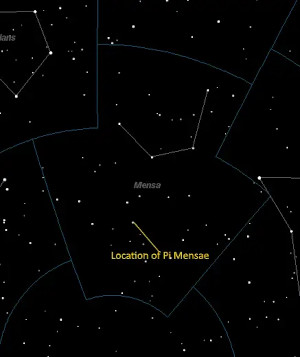
Few days before the formal acceptance of this paper, an independent study about the architecture of the π Men planetary system was published(1). The results of that work, based on public data and not including the ESPRESSO observations, confirm the high mutual inclination of the orbital planes of π Men b and c. Our results are in agreement with those of Xuan & Wyatt and are characterized by a better formal precision.(2)Pi Mensae, or π Men, is a yellow dwarf star in the constellation of Mensa. We know that it has a little planetary system, constituted by two planets (or, if you prefer, we discover only two planets orbiting around Pi Mensae): Pi Mensae b, one of the most massive planets ever discovered, about 14.1 the mass of Jupiter, and Pi Mensae c, a super-Earth, about 4.5 the mass of our planet.
Xuan, J. W., & Wyatt, M. C. (2020). Evidence for a high mutual inclination between the cold Jupiter and transiting super Earth orbiting π Men. Monthly Notices of the Royal Astronomical Society, 497(2), 2096-2118. doi:10.1093/mnras/staa2033 (arXiv) ↩︎ ↩︎
Damasso, M., Sozzetti, A., Lovis, C., Barros, S. C. C., Sousa, S. G., Demangeon, O. D. S., ... & Rebolo, R. (2020). A precise architecture characterization of the Men planetary system. A&A, Forthcoming article doi:10.1051/0004-6361/202038416 (arXiv) ↩︎ ↩︎